

As Cargo Traffic Reroutes Off South Africa’s Coast, Look Who Else Is In The Deep End Paying The Price
Due to the current rerouting of global shipping, South Africa’s coastline has also come into sharper focus, seeing a surge in cargo traffic–and with it, the crucial concern over the proximity of vessels to marine mammals and the rising risk of fatal ‘ship strikes’. When Els Vermeulen, Chief Scientist at the University of Pretoria’s Mammal […]

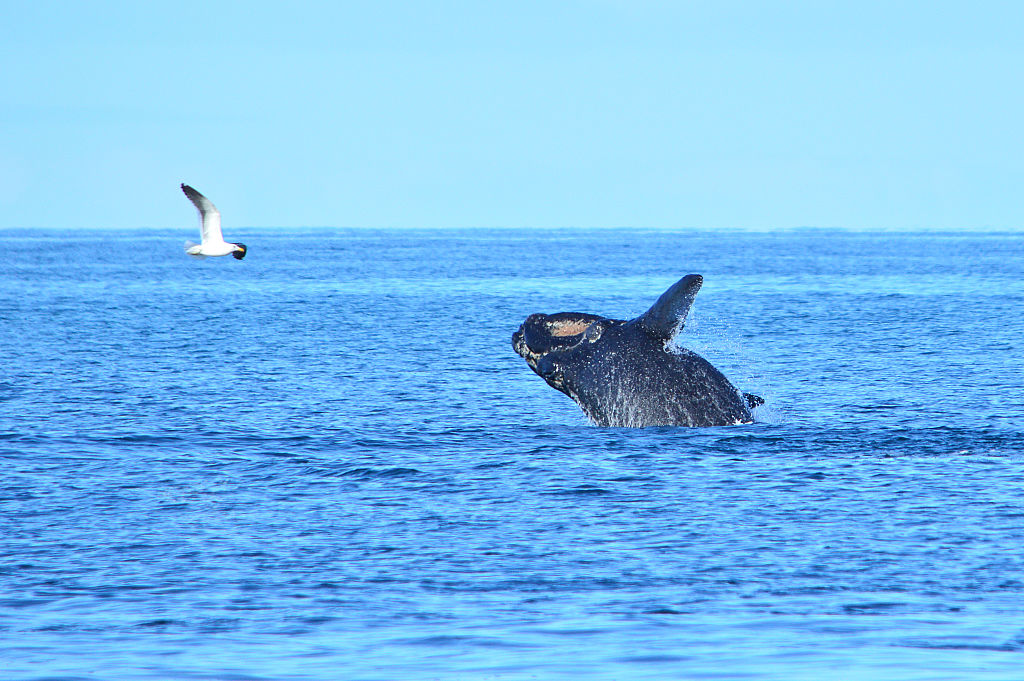
Due to the current rerouting of global shipping, South Africa’s coastline has also come into sharper focus, seeing a surge in cargo traffic–and with it, the crucial concern over the proximity of vessels to marine mammals and the rising risk of fatal ‘ship strikes’.
When Els Vermeulen, Chief Scientist at the University of Pretoria’s Mammal Research Institute (MRI) Whale Unit, noticed an increase in shipping activity around Cape Town, she knew she had to act quickly.
“I get concerned because I know these big vessels are going through large densities of whales,” Vermeulen, who has been aware of several deep-water whale sightings in recent weeks, tells FORBES AFRICA.
Her apprehension was warranted; the International Monetary Fund’s PortWatch report revealed that, between March and April this year, the number of commercial vessels traversing the Cape of Good Hope, the southern tip of South Africa’s Cape Peninsula, had indeed risen.
“One of the biggest threats to whales around the world is what we call a ‘ship strike’… Basically, being hit by ships, which happens most often in areas where you have a high density of whales and a high density of shipping,” Dr Simon Elwen, Director of Sea Search Research & Conservation, concurs to FORBES AFRICA.
When it comes to tracking shipping-related whale mortality, data is limited. Vermeulen correlates this to “cryptic mortality”, whereby most collisions occur deep offshore, and the deceased sink to the ocean floor.
It called for innovative research, which led Vermeulen and her team to overlap the distribution models of numerous whale species around the Western Cape province, with South African shipping routes, to dissect the “probability of a whale encountering a vessel”.
The findings revealed a notable increase in risk due to the current rerouting of global shipping, but Vermeulen admits that determining the population-level consequences for any whale species is difficult.
To overcome this ambiguous barrier, Vermeulen hopes to conduct offshore research by plane or boat. However, they need funding for this exercise, and at a time of heightened economic instability, this has been challenging.
Making matters worse is that this comes weeks before the commencement of South Africa’s infamous winter whale season, but, surprisingly, this doesn’t seem to keep Vermeulen up at night—it’s the summer months that have her worried.
She explains that while winter attracts various whale species, “especially the southern right whales”, who arrive to give birth, they stay close to the coastline. The summer, however, is feeding time.
That’s when South Africa’s West Coast welcomes the Benguela upwelling system, a highly productive marine ecosystem that lures “hundreds of humpback whales, southern right whales, fin whales, and other types of baleen whales… blue whales too.”
“When they reach those densities to come and feed in this region, that’s probably where my concern is highest because whales that are busy feeding might be less attentive to ships.”
Vermeulen also highlights the common sight of humpback “super groups”, adding that the risk of ship strikes rises significantly when they congregate.
“If a ship runs into one of these groups,” Elwen adds, “it can be 100-200 whales in a square kilometer feeding.”
Armed with new research, Vermeulen has ignited talks with the International Whaling Commission, the global body responsible for the conservations of whales, to establish standard shipping procedures for South African waters, exploring speed limitations and redirecting shipping routes further offshore or inshore.
“It’s something we’re discussing , and looking at the science a bit more closely… hopefully within the next couple of months, we will have the right measures in place.”
Comments (0)
Sign in to join the conversation.
Related Stories

Equatorial Guinea: Charting A New Era Of Sustainable Prosperity
With a renewed focus on diversification and digitalization, Equatorial Guinea is leveraging its resources to create inclusive, long-term growth. “Agro-processing is a key priority, as our goal is to ultimately achieve national self-sufficiency and independence.” President Teodoro Obiang Nguema Mbasogo Equatorial Guinea is entering a new phase in its economic story–one defined by diversification, competitiveness, and connection. […]

Foundations Strengthening A National Future
Policy reforms, national capabilities, and coordinated institutions reinforce long-term growth across Equatorial Guinea. Q. How is your ministry advancing the national development agenda across key sectors such as agriculture, energy, and tourism, and what priorities guide your efforts to drive long-term economic growth and self-sufficiency? Hon. José Juan Ndong Tom Mekina, Minister of Agriculture, Livestock, Forestry, […]

Equatorial Guinea’s Energy Reset And The Revival Of Its Hydrocarbons Sector
As Equatorial Guinea reshapes its position in the regional energy market, GEPetrol is steering the shift to secure production, attract reliable partners, and align upstream growth with long-term economic goals. “Our strategic vision is to develop projects that are sustainable in the long term, and that also revive the economy.” Bienvenido Nguema Envo, General Manager of GEPetrol In 2024, […]
Recommended




The Daily Brief