

Cliffs, Whales And Fynbos: Journeying Through A South African Nature Reserve
On my most recent trip to South Africa, I explored the entire 300km length of the Garden Route and its magnificent scenery. The route was dotted with beautiful coastal towns offering vistas of wide sandy beaches and tranquil lagoons. The meandering road which runs along the entire coast for miles is typically a few hundred […]

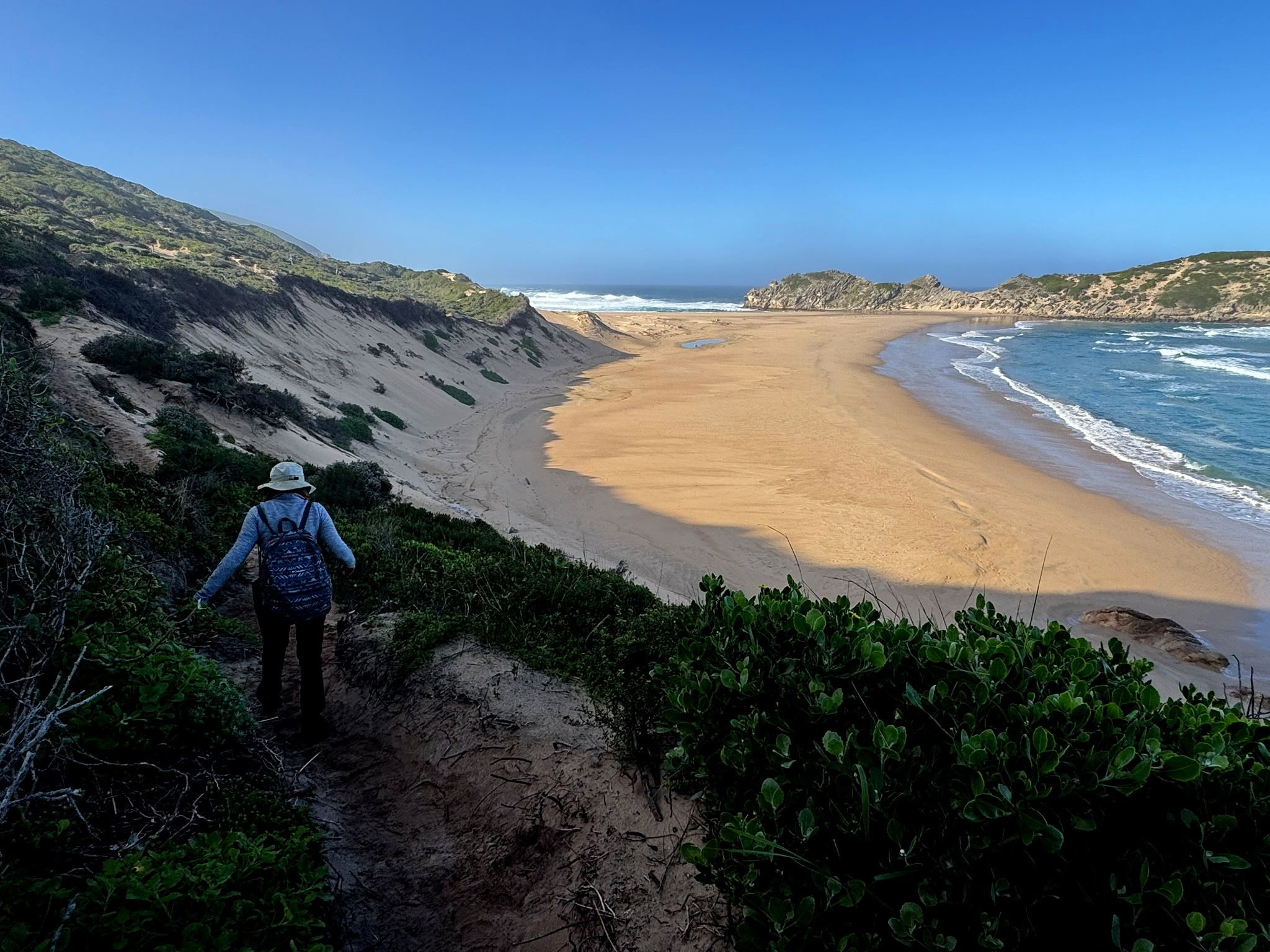
On my most recent trip to South Africa, I explored the entire 300km length of the Garden Route and its magnificent scenery. The route was dotted with beautiful coastal towns offering vistas of wide sandy beaches and tranquil lagoons. The meandering road which runs along the entire coast for miles is typically a few hundred feet above the ocean where powerful waves come crashing on the large sandy beaches providing for a remarkable sight.
One of my main interests on this trip was to trek in the Robberg Nature Reserve, a rugged peninsula characterized by uneven terrain requiring climbing over extensive rock outcrops and boulders.
The Reserve is associated with the prehistoric supercontinent Gondwanaland because its rocks provide evidence of Gondwanaland’s breakup 120 million years ago, and it was designated a World Heritage Site for this reason. The unitary mass of land that consisted of our continents was named Gondwanaland from its origins in central India home to the Gond tribes where similar rock began breaking up about 180 million years ago, splitting into Africa and South America to the west and India, Madagascar, Antarctica, and Australia. My excitement built up when my friend in Cape town called to inform me about a juvenile Humpback whale beached in the reserve.
I hurried to the Reserve and made Plettenberg Bay, a beautiful upscale town which serves as a gateway to the park, as my base. I was getting periodic updates from locals and the radio about restricted entry to parts of the reserve since rescue efforts were underway to save the whale. Whale strandings are known to happen especially among pilot whales when a disoriented mammal can lead the whole pod to run aground.
But in the case of this Humpback whale, it could have been injured or fallen sick, thereby losing its strength or becoming disoriented, leading it into shallow water. In places like the southern Cape, shallow, sloping beaches can confuse their sonar capabilities. Though wildlife management teams are well-trained in animal rescue, many factors prevent them from achieving a successful return of the whale to the sea.
The main challenge was the massive size and weight of the whale. While adult whales can weigh up to 40 tons, local experts estimated it to weigh around eight tons.
Once on land, the own weight of the whale can crush its internal organs and cause irreparable damage. The trauma of stranding, combined with dehydration and sun exposure, often puts the animal into shock mode. Even if a whale is put back to sea, it may strand again if it is confused, ill, or physically unable to swim effectively.
After several futile attempts, the rescue team decided to abandon the effort and euthanize the animal to put it out of its misery. When the park was finally opened, I rushed to see the whale, which was a good 6km away from the gate, and which started at the highest point and gradually led me onto the beaches.
The ocean view of crashing waves along the rocky outcrop for as long as the eyes can see was a treat. While the route was signposted, the ruggedness of the terrain in the more remote sections gave me cause for concern. I was walking along the edge of the rock wall with a sheer drop into the ocean with nothing to hold on to. The full loop of 9km involved elevation changes, including steep rock steps and dune descents, with an overall climb/descent of approximately 650ft. Upon landing at the beach after a steep descent from the dunes, I could see the outline of the dead baby humpback whale. Within the couple of days of its death, the strong sun had bleached the skin from gray to a pale yellow. In high tide, this whale could have attracted sharks, but I did not see any such signs. Putrefaction had already begun with a strong and
offensive odor emanating from the carcass. I walked around and took many photographs. Further from this beach was a small rocky outcrop known as The Point which becomes impassable at high tide, and one can get stranded on the rocky buff for many hours if you don’t consult tide times with the Reserve gate staff.
Another highlight of Robberg is the large Cape fur seal colony on the northern slope of the cliff. Here, these endemic seals can be observed swimming and playing. The area also receives southern right whales, humpback and Bryde’s whales, as well as bottlenose and humpback dolphins as it lies in their migratory route.
The abundant seabird population was also not lost to me. The trek, as it loops away from the water, passes through coastal thickets and a unique scrubland ecosystem called fynbos. Fynbos is a biodiverse shrubland of South Africa’s Cape Floral Kingdom, known for iconic plants like the King Protea and Ericas, thriving in a near Mediterranean climate of cold, wet winters and warm, dry summers, making it a global hotspot for rare, endemic species. Robberg is a paradise not to be missed.
Comments (0)
Sign in to join the conversation.
Related Stories

Equatorial Guinea: Charting A New Era Of Sustainable Prosperity
With a renewed focus on diversification and digitalization, Equatorial Guinea is leveraging its resources to create inclusive, long-term growth. “Agro-processing is a key priority, as our goal is to ultimately achieve national self-sufficiency and independence.” President Teodoro Obiang Nguema Mbasogo Equatorial Guinea is entering a new phase in its economic story–one defined by diversification, competitiveness, and connection. […]

Foundations Strengthening A National Future
Policy reforms, national capabilities, and coordinated institutions reinforce long-term growth across Equatorial Guinea. Q. How is your ministry advancing the national development agenda across key sectors such as agriculture, energy, and tourism, and what priorities guide your efforts to drive long-term economic growth and self-sufficiency? Hon. José Juan Ndong Tom Mekina, Minister of Agriculture, Livestock, Forestry, […]

Equatorial Guinea’s Energy Reset And The Revival Of Its Hydrocarbons Sector
As Equatorial Guinea reshapes its position in the regional energy market, GEPetrol is steering the shift to secure production, attract reliable partners, and align upstream growth with long-term economic goals. “Our strategic vision is to develop projects that are sustainable in the long term, and that also revive the economy.” Bienvenido Nguema Envo, General Manager of GEPetrol In 2024, […]
Recommended




The Daily Brief