

Forced To Flee His Home Country, The South Sudanese NBA Player Now Building Courts For Refugees
Wenyen Gabriel’s path to the Olympics and moments bigger than basketball was an unlikely one. Undrafted in 2018 and remade in the G League, the development league of the NBA, Gabriel represented South Sudan on the biggest stage in sport—and now returns to the country his parents fled, building courts for the refugees his own […]

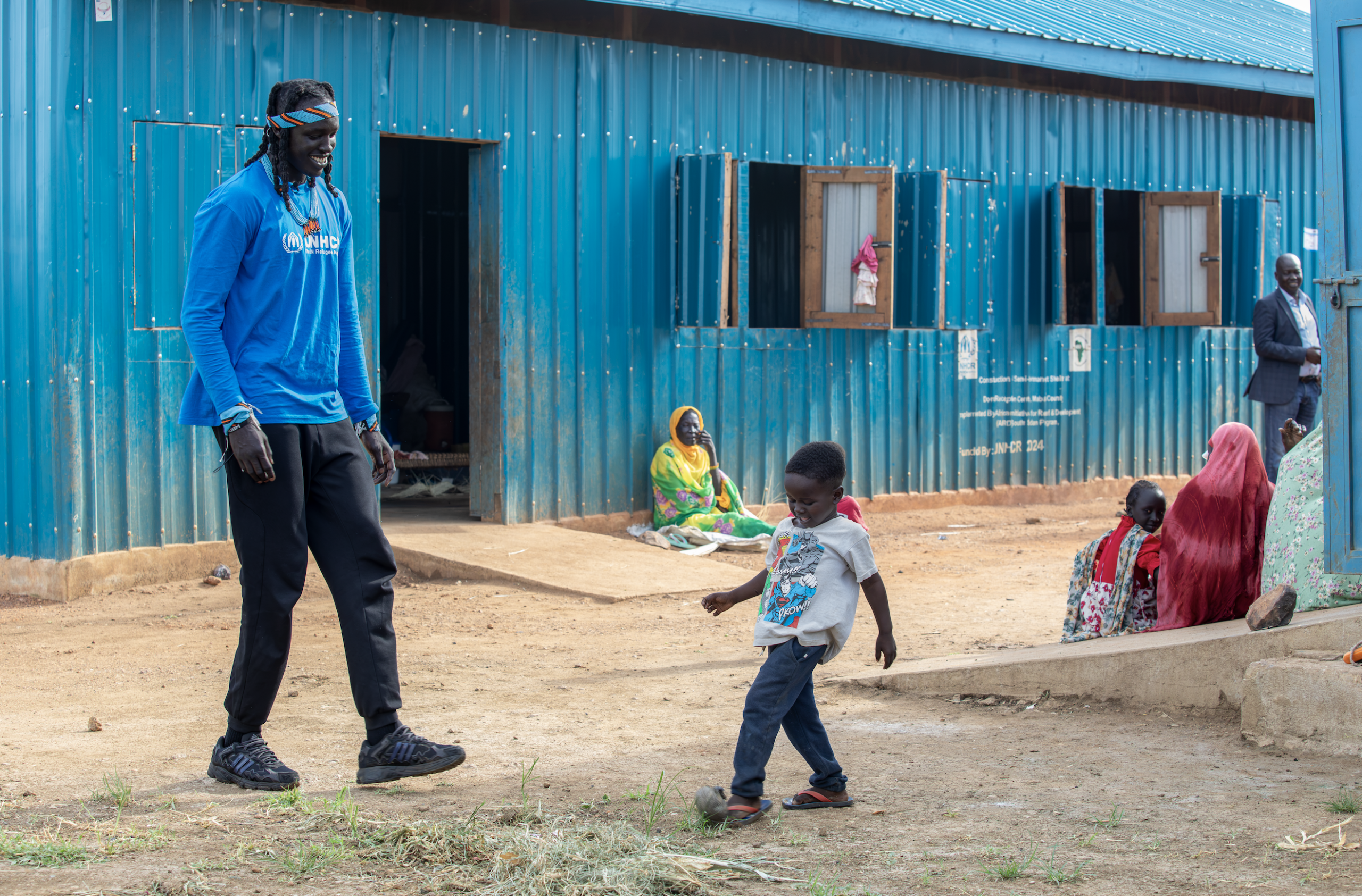
Wenyen Gabriel’s path to the Olympics and moments bigger than basketball was an unlikely one.
Undrafted in 2018 and remade in the G League, the development league of the NBA, Gabriel represented South Sudan on the biggest stage in sport—and now returns to the country his parents fled, building courts for the refugees his own family once were.
“Playing my first minutes in the NBA is something I’ll never forget,” Gabriel says to FORBES AFRICA of his debut for the Sacramento Kings. “I remember thinking about my family and everything it had taken to get there… I was born in exile after my family fled South Sudan, and now I was sharing an NBA court with the giants. And honestly, that feeling is still there.”
He does not remember the war that put him on that court.
Gabriel’s parents lived in Rumbek, a market town in what is now South Sudan’s Lakes State, long before it was a state at all and before South Sudan was even a country. The Second Sudanese Civil War, which raged from 1983 to 2005, between Khartoum and the southern-led rebel movement, would kill an estimated two million people and displace four million more. It chased Gabriel’s parents out of Rumbek and north to Khartoum, he says, after they sold what little they had to find safety in the Sudanese capital. In 1997, Gabriel was born as the fourth child.
Khartoum offered no way forward. His father had no work, so, like many displaced families, journeyed to Cairo in Egypt. Here, his mother cleaned houses, and his father volunteered at the United Nations Refugee Agency (UNHCR) office along with odd jobs, while they waited on a resettlement application.
The timing worked in their favor: by 1999, departures out of Egypt had surged.
Among that wave came a ticket for the Gabriels—then a flight, then New Hampshire: a small, unfamiliar corner of America that would soon become their home.
His parents worked two jobs each, picking up a language neither of them initially spoke. “They never complained,” Gabriel says. “They knew what it was like to have nothing at all. Safety and education for their children was more than they had hoped for in a while.” But Gabriel and his siblings had set their sights much higher.
Basketball was his sister’s passion before it was his. She was recruited to a prep school on a scholarship, then to Boston College. Gabriel had been trying to follow in her footsteps since middle school, applying to prep schools. Financial aid covered most of the cost, but not all of it. “The money my parents made was for sustenance,” Gabriel says. “There was no extra money.”
Older by seven years, his brother offered to cover it by working a job. “He said, I’ll pay for the school for you, so you can go there and just focus on basketball,” Gabriel says. He went in with zero scholarship offers, but later got 23 of them. He was ranked the 14th-best player in the country and committed to the University of Kentucky.
Then, in 2018, after the success of recent years at the collegiate level, Gabriel faced a major setback to his dreams; he went undrafted.
“It was a sad night. I didn’t talk to anybody,” he says. Teams called only to offer to stash him overseas without a real contract, until the Sacramento Kings called with no pick in his range but genuine interest, and the promise of a two-way deal. He took the gamble. A rough start at summer league in Las Vegas gave way to his shot, and he signed with Sacramento—spending most of that first year in the G League when many people were saying “he’s not an NBA player,” Gabriel recalls.
“Giving up is not an option,” he says. “That’s the only real failure.” He recounts how a stress fracture in his foot led to him being cut before the season was out. The Kings brought him back anyway the following year. He grinded through a strong summer league and training camp, and on the last day, he earned the final open roster spot. He went home and cried. Even then, he was more G League than NBA—until a trade sent him to Portland, and with it, his first real chance in the league.
Success did not settle him; it turned his mind outward, to the hardship his own family had outrun. He now wished to hand someone else the chance he had been given.
Three years later, in 2022, Gabriel made his first trip to South Sudan. He ran a basketball camp, and visited camps for people internally displaced by conflict. He built a court in Juba, the capital, and returned each year. “There are levels to not having anything,” he says. “Even to this day I go to Rumbek or Juba, and I see they have a difficult life. Then I go to the refugee camps, and I see what really having nothing means.”
Two years later, in Paris, came a different kind of homecoming. South Sudan had qualified for the Olympics for the first time in its history, and a six-foot-nine Gabriel, in his country’s jersey for the first time, stood to sing its anthem. “Playing in the NBA was special and something I’ll never forget, but representing my country at its first-ever Olympics was life-changing,” he says.
“My family had been forced to flee South Sudan, and now I was standing there… I thought about my family, everything they had been through, and how far we had come as a country.”
South Sudan opened its Olympic history by beating Puerto Rico 90-79 on July 28, 2024, Gabriel finishing with six points, nine rebounds, and two blocks. “That moment was bigger than basketball,” he says. “We were representing South Sudan and South Sudanese people around the world.”
This year, he opened a second court in Maban, in South Sudan’s northeast, where nearly 220,000 people who have fled the war in Sudan now shelter alongside a host community of some 80,000 South Sudanese—one corner of a crisis UNHCR calls the largest displacement emergency in the world today, having uprooted more than 14 million people since April 2023.
Gabriel’s newest title was made official: UNHCR Goodwill Ambassador, becoming the first professional basketball player to hold the role.
He takes on the title at a difficult time. UNHCR’s 2026 funding requirement stands at $8.5 billion; by the end of June, only 31% of it had been met, the agency’s global spokesperson Eujin Byun confirms to FORBES AFRICA.
Gabriel is unsentimental, too, about the politics surrounding people like his own family. “I think it’s a misconception that refugees are a burden,” he says. “They come in with a high work ethic, and they make these communities better. People don’t want to promote that.”
It is a case he is uniquely positioned to make. Gabriel’s family’s own resettlement out of Cairo is now a rarer route than it once was. Global resettlement departures fell by more than half between 2016 and 2025, per UNHCR, even as demand for it keeps climbing. He knows precisely what was handed to him, and how few now receive the same.
“No one chooses where they’re born… I think everyone deserves a chance. That’s why I’m here.”
Comments (0)
Sign in to join the conversation.
Related Stories

Equatorial Guinea: Charting A New Era Of Sustainable Prosperity
With a renewed focus on diversification and digitalization, Equatorial Guinea is leveraging its resources to create inclusive, long-term growth. “Agro-processing is a key priority, as our goal is to ultimately achieve national self-sufficiency and independence.” President Teodoro Obiang Nguema Mbasogo Equatorial Guinea is entering a new phase in its economic story–one defined by diversification, competitiveness, and connection. […]

Foundations Strengthening A National Future
Policy reforms, national capabilities, and coordinated institutions reinforce long-term growth across Equatorial Guinea. Q. How is your ministry advancing the national development agenda across key sectors such as agriculture, energy, and tourism, and what priorities guide your efforts to drive long-term economic growth and self-sufficiency? Hon. José Juan Ndong Tom Mekina, Minister of Agriculture, Livestock, Forestry, […]

Equatorial Guinea’s Energy Reset And The Revival Of Its Hydrocarbons Sector
As Equatorial Guinea reshapes its position in the regional energy market, GEPetrol is steering the shift to secure production, attract reliable partners, and align upstream growth with long-term economic goals. “Our strategic vision is to develop projects that are sustainable in the long term, and that also revive the economy.” Bienvenido Nguema Envo, General Manager of GEPetrol In 2024, […]
Recommended




The Daily Brief