

‘My Fight Is That Africa Does Not Remain A Dustbin’: How ‘The Plastic Man’ Is Taking On The Waste Crisis
Often draped in plastic, Modou Fall, widely known as ‘The Plastic Man’, has made it his life’s purpose to eradicate plastic waste. As the founder of the environmental association, Clean Senegal, Modou Fall travels the country, educating schools, organizing clean-ups, and campaigning against single-use plastics. “We organized an ecological march from Dakar to Saint Louis, […]

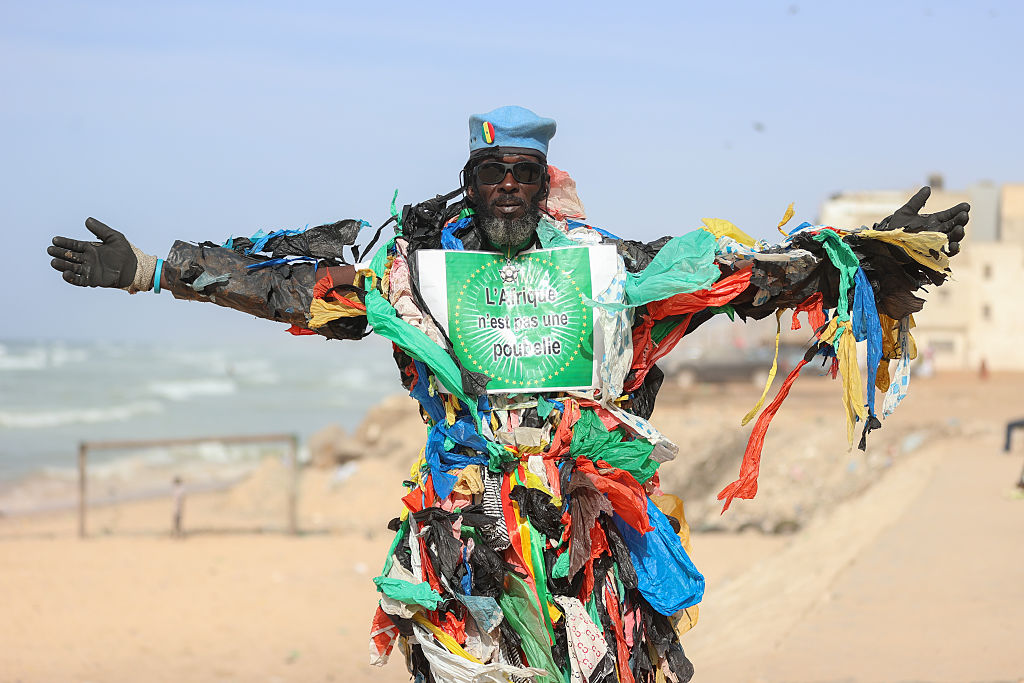
Often draped in plastic, Modou Fall, widely known as ‘The Plastic Man’, has made it his life’s purpose to eradicate plastic waste.
As the founder of the environmental association, Clean Senegal, Modou Fall travels the country, educating schools, organizing clean-ups, and campaigning against single-use plastics.
“We organized an ecological march from Dakar to Saint Louis, walking 10 days over 270 kilometers, to raise awareness about environmental education,” he tells FORBES AFRICA.
Fall’s efforts earned him the National Order of Merit in 2015 in Senegal, a milestone that, he says, gave him the self-validation needed to continue his mission.
“I will continue to fight until the last breath of my life,” Fall declares.
This realization that plastic will be forever intertwined with modern society is vital to creating tailored solutions. Trying to eradicate waste altogether is an almost impossible feat, meaning one must pick their battles wisely.
To combat the continuous stream, Fall sees circular solutions as the most potent avenue to tackling plastics’ omnipresence. There’s no shortage of waste across the continent, underscoring the yin and yang of opportunity and the dire reality.
It’s in rotting landfills, suffocating lakes and inundated waterways, and will remain publicly residual until collaborative motives are implemented.
With the ability to create jobs and expand industries, waste could become a provider rather than a suppressor. Concentrated public and private funding is required to unlock the treasures of pollution, potentially transforming an everyday pain into a collective gain.
“My fight is that Africa doesn’t remain a dustbin. It is time that we use our resources to create our own plastics industry, develop ways to repurpose certain waste, and educate children. We must prioritize recycling systems because we can no longer live without plastic,” Fall concludes.
Comments (0)
Sign in to join the conversation.
Related Stories

Equatorial Guinea: Charting A New Era Of Sustainable Prosperity
With a renewed focus on diversification and digitalization, Equatorial Guinea is leveraging its resources to create inclusive, long-term growth. “Agro-processing is a key priority, as our goal is to ultimately achieve national self-sufficiency and independence.” President Teodoro Obiang Nguema Mbasogo Equatorial Guinea is entering a new phase in its economic story–one defined by diversification, competitiveness, and connection. […]

Foundations Strengthening A National Future
Policy reforms, national capabilities, and coordinated institutions reinforce long-term growth across Equatorial Guinea. Q. How is your ministry advancing the national development agenda across key sectors such as agriculture, energy, and tourism, and what priorities guide your efforts to drive long-term economic growth and self-sufficiency? Hon. José Juan Ndong Tom Mekina, Minister of Agriculture, Livestock, Forestry, […]

Equatorial Guinea’s Energy Reset And The Revival Of Its Hydrocarbons Sector
As Equatorial Guinea reshapes its position in the regional energy market, GEPetrol is steering the shift to secure production, attract reliable partners, and align upstream growth with long-term economic goals. “Our strategic vision is to develop projects that are sustainable in the long term, and that also revive the economy.” Bienvenido Nguema Envo, General Manager of GEPetrol In 2024, […]
Recommended




The Daily Brief