

Reefs On The Rise: Africa’s New Underwater Economy
One of the ways you can see a city’s growth is through its shifting skyline. From towering skyscrapers to cranes and buildings that keep multiplying, construction is the barometer of the economy. But beyond the urban centers, there are different kinds of neighborhoods being engineered–interconnected, underwater worlds for marine life that function as both infrastructure […]

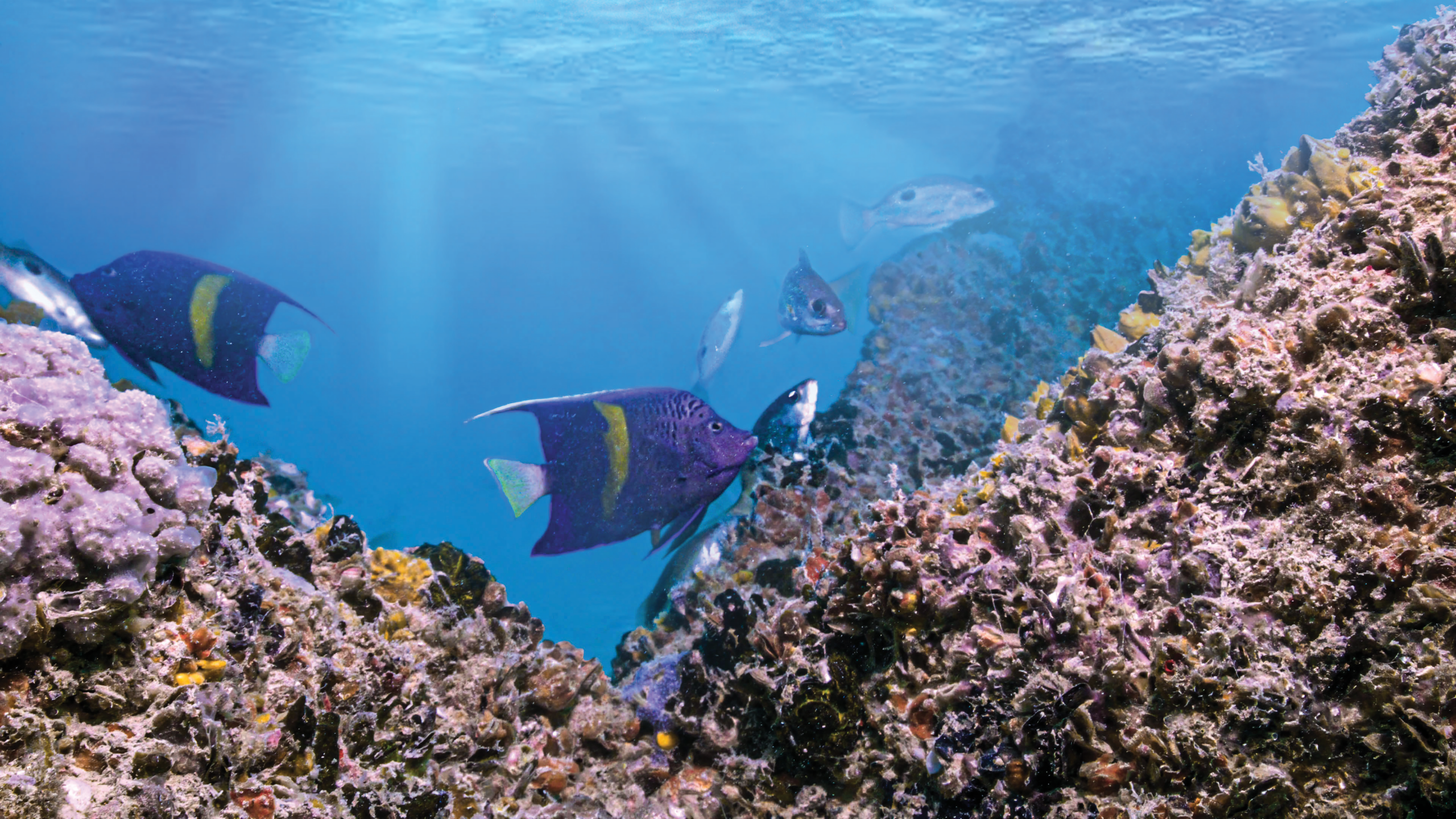
One of the ways you can see a city’s growth is through its shifting skyline. From towering skyscrapers to cranes and buildings that keep multiplying, construction is the barometer of the economy. But beyond the urban centers, there are different kinds of neighborhoods being engineered–interconnected, underwater worlds for marine life that function as both infrastructure and intervention. The seafloor gets its own zoning, architecture and residents in the form of artificial reefs.
“Natural reefs are incredibly complex, slow-built ecosystems that do everything from protecting shorelines to supporting fish stocks and reef-dependent livelihoods,” explains Dr Camilla Floros, a marine scientist and coral reef ecologist at Oceans Without Borders who works in East Africa (and mainly on the Bazaruto Archipelago in Mozambique and the Mnemba Island Marine Conservation Area in Zanzibar).
Across Africa’s coastline, reef restoration is quietly gaining ground. In Zanzibar, Oceans without Borders deployed six custom-designed artificial reef structures near Mnemba Island, transplanted with coral micro-colonies from a local nursery to reduce tourist pressure on the main house reef. In Morocco, seven-meter-high concrete pyramids were deployed in the Martil Sea to create underwater habitats and combat illegal trawling. In Algeria, reef-building has been a grassroots effort.
A diving association in Annaba, Hippone Sub, deployed the country’s first artificial reef in 2016 on a United Nations (UN) Development Programme grant, then worked with the government to develop a legal framework that didn’t yet exist. In May, the Seychelles deliberately sank a 46-meter decommissioned Coast Guard patrol vessel to create both reef habitat and a diving attraction.
“Artificial reefs can’t replace natural reefs. Full stop,” says Floros. “What they can do is help natural reefs bounce back faster–by creating habitat, attracting fish, stabilizing rubble and giving coral fragments a place to grow.”
Underwater ambitions
In the Middle East, spanning 600sqkm and made up of 20,000 modules, Dubai Reef is one of the most impressive marine conservation projects worldwide.
Yousuf Lootah, CEO of Corporate Strategy and Performance and the head of the Dubai Reef initiative in Dubai’s Department of Economy and Tourism, says: “Globally, over the past 50 years, the marine population has been dropping so we looked into different ways to protect our marine life as part of a wider, Dubai environmental agenda.”
The idea began quietly in 2021 with a pilot of just 10 modules, deployed to test whether purpose‑built reefs would take in Dubai’s waters. Within two years, the sites showed rapid colonization by invertebrates and fish, and that was enough to scale the project.
Compared to Algeria’s Annaba or Zanzibar’s Mnemba, where reef-builders mostly work on to existing rock or degraded reef, Dubai’s warmer, moving seabed is unusually challenging. To get the designs right, Dubai partnered with a South Korean firm that had already deployed artificial reefs in Australia and Oman. “We looked at the limitations of the Dubai waters–the shipping lines, and the oil field–to define the areas which we could deploy,” says Lootah. “We also looked at the different species that we wanted to grow from a fish stock perspective as well as other forms of marine life, from coral to oysters to the creatures that build up the food pyramid all the way to the pelagic species.” This is one of the reasons the modules come in different shapes and sizes–some are designed for smaller, reef‑hugging fish, while others cater to larger pelagic species that move in and out of the structures.
“The modules are designed and positioned in a way that actively supports marine life,” explains Dr Juan Antonio Romero, marine biologist, Mission Blue scientist and executive senior advisor (Environment, Conservation and Research) at Dubai Reef.
One of the biggest misconceptions around artificial reefs is that people imagine them as ‘instant coral reefs’. “And they’re not,” says Floros. “They’re tools, basically scaffolding that gives marine life a chance to come back in places where reefs have been damaged.”
In African coastal systems, where overfishing, reef damage and coral bleaching are common, artificial reefs help speed up recovery, but they can’t magically fix everything on their own. “If local pressures don’t change, they just become underwater structures with no ecosystem comeback,” she adds. Lootah says that it’s equally important that the modules are future-proof, built to survive climate events like rising sea temperatures or bleaching (when coral turns ghost‑white after expelling the algae they depend on) and to remain structurally sound on the seabed for more than 100 years. “We’ve seen other people going into this field and build using byproducts from other industries,” he adds. “We found that to be a little risky when it comes to cross contamination.” (Interestingly, in Annaba, marine biologist Farid Derbal found metal colonized faster than concrete, logging around 47 species in a single four-cubic-metre module within six months.)
Below the surface
Dubai Reef has attracted substantial global interest. African marine engineers and environmentalists are looking to the construction models used in Dubai as a blueprint for reversing coastal degradation along the continent. “For us, artificial reefs are part of a bigger strategy to restore coral ecosystems and rebuild fish populations,” says Floros. “Projects only succeed when local people are involved in the design, the diving, the science and the stewardship.” The units were first deployed in 2021 and two years later, the project was publicly announced at COP, the annual UN climate summit. The following year, Dubai’s rulers marked the inauguration of Dubai Reef with an underwater dive alongside billionaire investor and ocean advocate Ray Dalio. “That was a proud moment that kind of signaled to the world, and to the community here, how serious we are about protecting our sea,” says Lootah. Another eye-opening moment for Lootah came when he learned how to dive. Although he had encouraged many others to join the conservation effort, it was only when he saw the artificial reefs for himself and how they were prospering that something inside of him shifted. “I haven’t gone fishing after that,” he admits.
And this is still only the beginning. To date, over 11,000 modules have been fabricated and over 8,000 are already in the water, ahead of schedule. The individual artificial reef structures make up around 550,000sqm of habitat surface. Six designs in total, ranging from 1.7m to 6.5m tall, with the largest weighing 15 tons.
“I’m also now more excited about the next 10 years and how this is going to change the waters of Dubai,” says Lootah. Dubai is already a global hub for work and travel, but Dubai Reef is also a calculated entry into the blue economy at a global scale. For Dubai, the reef is a portfolio. From Annaba to Bazaruto, it’s a pantry. “The ocean generates the most oxygen for the world. It’s the largest source of carbon sequestration, more than trees, and a huge chunk of the global population depend on the ocean as a food source,” he says. “I think we will see more and more countries looking at this because one of the key things, besides creating fish stock security, it creates a nature reserve bank.”
– This article was modified on September 14, 2026
Comments (0)
Sign in to join the conversation.
Related Stories

Equatorial Guinea: Charting A New Era Of Sustainable Prosperity
With a renewed focus on diversification and digitalization, Equatorial Guinea is leveraging its resources to create inclusive, long-term growth. “Agro-processing is a key priority, as our goal is to ultimately achieve national self-sufficiency and independence.” President Teodoro Obiang Nguema Mbasogo Equatorial Guinea is entering a new phase in its economic story–one defined by diversification, competitiveness, and connection. […]

Foundations Strengthening A National Future
Policy reforms, national capabilities, and coordinated institutions reinforce long-term growth across Equatorial Guinea. Q. How is your ministry advancing the national development agenda across key sectors such as agriculture, energy, and tourism, and what priorities guide your efforts to drive long-term economic growth and self-sufficiency? Hon. José Juan Ndong Tom Mekina, Minister of Agriculture, Livestock, Forestry, […]

Equatorial Guinea’s Energy Reset And The Revival Of Its Hydrocarbons Sector
As Equatorial Guinea reshapes its position in the regional energy market, GEPetrol is steering the shift to secure production, attract reliable partners, and align upstream growth with long-term economic goals. “Our strategic vision is to develop projects that are sustainable in the long term, and that also revive the economy.” Bienvenido Nguema Envo, General Manager of GEPetrol In 2024, […]
Recommended




The Daily Brief