

The New Capital Of Capital: West Africa’s Fintech Surge
With a surge of fintech innovators and diverse product offerings, startups in West Africa are reshaping the continent’s financial landscape. Armed with ambition and artificial intelligence, securing investor interest and millions in funding, the sector is looking to lead the continent into an age of digitalization, economic prosperity and widespread accessibility, proving that Africa is […]


With a surge of fintech innovators and diverse product offerings, startups in West Africa are reshaping the continent’s financial landscape. Armed with ambition and artificial intelligence, securing investor interest and millions in funding, the sector is looking to lead the continent into an age of digitalization, economic prosperity and widespread accessibility, proving that Africa is ready to take its place as an innovative and creative global hub.
Additional Reporting: Chanel Retief and Nicole Pillay
Art Director: Manelisi Dabata
Photography: Kelechi Amadi-Obi
Photography Assistants: Chukwudi Ademu, Vincent Okoro, Kingsley Ugwukozor, Musa Alabi, Jesutofunmi Amokeoja, Anthony Ibuzo
Stylist: Isaac Isiadinso (Kookavelli) Stylist’s Assistant: Timilehin Oshinbanjo
Outfits: VREEMD, RAEY, Soft aiv couture and Berluti
Makeup & Hair: Oluwatoyin Eko
Studio: 12 Temple, Lagos, Nigeria
On a humid Monday morning in mid-July, light filters softly through the floor-to-ceiling windows of an apartment in Ikoyi, a neighborhood in Nigeria’s commercial capital of Lagos, and one permeating with the super-rich. The studio lights are set and cameras are perched on tripods as a stylist adjusts the collar of a traditional outfit worn by a fintech chief executive in the room–one whose particular focus is that of cryptocurrency.
One by one, several tech entrepreneurs arrive. The co-founder of a payment and business banking startup is already seated, flipping through notifications on his phone—pausing only for a moment when a noteworthy update from the world of fintech pops up. Another comes in moments later, eyes still fixed on the surrounding environment as he finishes up a call with a venture capital firm. Exchanging pleasantries with an air of familiarity, our final co-founder turns to the mirror to adjust his jacket.
Donning loafers, smart watches, and the occasional touch of traditional agbada—the effortless style typical of startup culture—these four Nigerian contemporaries represent only a subset of a large number of West African tech trailblazers. They may speak different languages—French, Yoruba, Twi—but they are all fluent in the lingua franca of fintech: coding, funding rounds, regulatory frameworks and scale.
What unites them isn’t just their geography. It is a shared understanding that the future of finance in Africa cannot be decided only in the boardrooms of traditional banks, but also in cafés, co-working hubs, and WhatsApp groups. From Lagos to Senegal’s Dakar, these are the new architects of an emerging economic order. And they are doing more than launching startups—they are shifting power.
Strong Roots, Steady Growth
The expansion of fintech on the continent isn’t just about apps, APIs, and digital wallets; it’s about transformation—and a transfer of economic influence from traditional institutions to young innovators.
“We’ve always seen the power of partnerships within the fintech ecosystem,” says Ayotunde Alabi,
the CEO of Luno Nigeria, during a break between group shots at the photoshoot in Ikoyi.
“Our goal is to continue to be a part of Africa’s growth story, driving the future of finance while providing innovative, accessible, and secure solutions.”
West Africa, and Nigeria in particular, has become the beating heart of Africa’s fintech boom. Four of the continent’s fintech unicorns—Flutterwave, OPay, Interswitch, and Moniepoint—were either founded in Nigeria or operate from it.
But this wave is far from national.
Benin-born entrepreneur Dare Okoudjou founded the reported soonicorn, Onafriq (formerly MFS Africa) in South Africa more than a decade ago.
As Okoudjou has reportedly put it, he had “a simple measure of success for the business: to facilitate access for his mom’s honey business in Porto-Novo, Benin, to collect payments from her customers from across the continent–and to make the process as easy as a phone call”.
In Ghana, mobile money penetration is among the highest in West Africa. In Senegal, startups like Wave are reimagining banking with just a phone number. From Côte d’Ivoire’s Orange Bank to Sierra Leone’s recent push for blockchain-backed microfinance platforms, the West African corridor has become one of the most dynamic for financial innovation in the Global South.
Much of this momentum has come as a result of the weak financial infrastructure. With reportedly more than half of West Africa’s population still unbanked, fintechs have emerged not only as convenient alternatives but as necessities—bridging the gaps in trust and geography. Increasingly, they’re also exporting those models to the rest of the continent and beyond.
Still, building a business in West Africa is not without friction. Founders seem to constantly toggle between optimism and fatigue. Regulations shift without warning, foreign exchange volatility impacts pricing, and infrastructure—from broadband to basic electricity—can be patchy and inconsistent. However, the ecosystem remains audaciously ambitious.
At the FORBES AFRICA photoshoot, the four fintech leaders easily drift into casual conversation—some debating API integrations, others bantering about current affairs in the world of tech. No one speaks of exits. They are still building and still betting that the next billion-dollar story would come from this region.
They are also betting big on each other. It’s hard not to sense the hum of something revolutionary in the air.
While competition among West African fintechs is fierce, collaboration tends to trump rivalry. Founders can co-invest in each other’s companies, like payments company, Flutterwave did with Piggytech, the parent company of savings platform PiggyVest, through a Simple Agreement for Future Equity (SAFE) in mid-2023.
And, in a region where state support can, at times, be unreliable, solidarity has become its own kind of infrastructure. What’s emerging is not just a new class of entrepreneurs, but a new type of ‘power broker’–one less defined by suits and skyscrapers, and more by code commits and community trust.
“Finance is going to be embedded. That is the next stage we are entering now,” says Somto Ifezue,
CEO and Co-Founder of PiggyVest.
This is clearly the perspective of someone who believes there’s already a lot of available data to help people make informed financial plans.
“The generation right now won’t be thinking about money as just figures but what it can do for them,” he adds, as the others nod in agreement.
Outside, the city has come alive—horns blaring, engines rumbling, businesses opening up shop. Inside this studio, a steady transformation had already begun.
Nigeria’s Dominance In The Fintech Ecosystem
The story of Nigeria’s fintech surge didn’t begin with billion-dollar valuations. It began with subtlety, in the early 2000s, when the country’s banking sector was unsettled and rebuilt after a series of reforms.
Notably, with the launch of Interswitch in 2002 came the establishment of Nigeria’s first electronic transaction and switching infrastructure, the idea of fintech started to slink into fruition. As institutions consolidated and regulators tightened the reins, an unexpected sphere opened up—one that wasn’t designed by government or multinationals, but forged by necessity and nimble, local entrepreneurs.
Fast-forward two decades, and Nigeria is now affiliated with four fintech unicorns as well as two other companies—PalmPay and Kuda—reportedly considered to be ‘soonicorns,’ with valuations hovering near the billion-dollar mark.
In July, 10 African fintechs were named among the world’s top 300 fintech companies in 2025 by CNBC and Statista. These include Interswitch, PalmPay. Moniepoint, M-KOPA, OPay, and PiggyVest, as well as Egypt’s Paymob and Myfawry, Kenyan company, Tala, and Yoco from South Africa.
And the fintech pool continues grow in Nigeria, with reports indicating that there were more than 430 fintech companies by February 2025, and billions in investment estimated to be flowing into the sector over the last five years.
The country’s major African financial center, Lagos, hosts most of these companies and has emerged as the world’s top emerging tech hub, according to the recent Global Tech Ecosystem Index published by intelligence platform, Dealroom.
But why Nigeria? And, why now? The answer, as it often happens, is a mixture of adversity and ambition amongst the youth.
Some would say that Nigeria is a country built for mobile. While nearly 48% of the over 200 million people, as of 2023 and per the Access to Finance (A2F) survey report, remains unbanked or underbanked, mobile phone adoption stands at over 93%. Also, financial exclusion improved from 32% in 2020 to 26% in 2023.
Traditional banks—often hindered by high fees, bureaucratic hurdles, and opaque systems—may never reach deep enough into the population. The result: a vacuum that fintech rushed in to fill years ago.
For Nigeria’s younger generation–about 70% of the population is under 30–fintech isn’t just convenient, it’s a lifeline, and a means to save, send, and spend in a digital world.
As Iyinoluwa Aboyeji, Founding Partner of Future Africa–a venture capital and private equity investor– puts it: “All you’re seeing today is the result of 10 years of dedicated work by people who slaved, begged, grifted—whatever they had to do to make sure this ecosystem worked for the technology sector. But it’s not sustainable at scale, right? We need to be thinking about how to take five unicorns to 30. How do we take 100,000 people working in the digital economy to 10 million?”
At the time, challenges–like glaring gaps in access to finance, chronic unemployment, and regulatory inertia–became, paradoxically, its greatest advantage. Entrepreneurs, many of them in their 20s and 30s, weren’t just solving problems for Nigeria; they were solving problems for the world.
Crucially, this ecosystem didn’t grow in a vacuum. Nigeria’s vast diaspora, with deep pockets and deeper ties to home, played an instrumental role.
In 2024 alone, Nigeria received more than $20 billion in personal remittances. Many of the startups that now define the fintech landscape—like Paystack, acquired by Stripe, reportedly, for $200 million in 2020—were either seeded or supercharged by Nigerians abroad. They brought capital, frameworks, mentors, and networks.
Lagos, dubbed by some as ‘Africa’s Silicon Valley’, has increasingly caught the attention of global venture capitalists. According to research platform, Africa: The Big Deal, Nigerian startups ranked third in Africa for attracting investor funding in the first five months of 2025, securing over $162 million in capital.
However, some of Nigeria’s founders believe that what these financial backers often miss is the uniqueness of the country’s infrastructure.
“Nigeria has a very sophisticated payment network. Instant payments and bank transfers that take just seconds have been standard in the country for nearly two decades. That ability to move money quickly across banking networks creates the perfect environment for fintech,” says Ola Oyetayo, CEO and Co-Founder of Verto, a B2B cross-border payment company.
In terms of the traditional banking system, despite reforms, most banks struggle to onboard new customers, reportedly citing KYC (Know Your Customer) hurdles, outdated backend infrastructure, and a regulatory environment that often oscillates between innovation and protectionism.
Many Nigerians still rely, heavily, on cash. However, according to reports, when cash shortages occurred during the 2023 currency redesign by the Central Bank of Nigeria, fintechs like Opay, Moniepoint, and PalmPay provided a welcome stopgap, processing millions of transactions daily, offering agency banking through local merchants, and keeping economic activity going.
This forward momentum doesn’t only apply to Nigeria.
Senegal became the first country in West Africa to birth a unicorn outside Nigeria when Wave, a mobile money platform, raised $200 million in 2021. With an ultra-low-cost model, it has transformed mobile money in Francophone West Africa, where telecom-led mobile banking, traditionally, dominated.
Also, across the region, startups like Onafriq and InTouch are pushing innovation in cross-border payments and merchant services.
As Nigeria’s fintech landscape matures and continues to take the lead, the question becomes not whether it can innovate, but whether it can scale. For Aboyeji, the biggest challenge is ambition.
“There isn’t enough recognition. Look, we’ve gone so far, but the journey is still so much longer to become a global hub for technology and talent.
“For me, I just feel like there’s so much work we have to do to just wake people up to say, ‘guys, we just started. This is not the time to rest on your oars, and we’ll never be better positioned than we are now’.”
He sees this moment as an inflection point—a brief window where Nigeria could pivot from being an ecosystem of promise to a global engine of innovation. But, it requires something that has long been in short supply: coordinated vision.
West Africa: Leading With Legacy And Ambition
As dusk settles over Lagos, the pulse of West Africa’s tech capital still hums. From the neon-lit cafes in Victoria Island to the co-working spaces dotting Yaba, the city thrums with an energy that has become West Africa’s signature in the digital age: loud, improvisational, and deeply ambitious.
Perhaps, this is why multinational investors are increasingly using Lagos, Accra and Dakar as launchpads, not just for African expansion, but for global experimentation.
“To our Nigerian tech leaders,” Olatubosun Alake, the Lagos State Commissioner for Innovation, Science and Technology said, scanning the crowd of a recent high-profile technology forum, “you’ve already proven that you can scale with grit. Now scale with alliances. Always remember: 2% of something is usually better than 100% of something less.”
Dami Hastrup, Founder and CEO of U.K.-based virtual reality training platform, Moonhub tells, FORBES AFRICA: “Lagos itself is a city that, if it likes something innovative, it will adopt it and we’ve found that already with the companies that we’ve met with here. They’ve been incredibly welcoming and forthcoming. I definitely see there being room to collaborate with companies here in Lagos.
“I consider the future of the tech ecosystem here in Nigeria to actually become one of the backbones of the country… so very excited to see how the ecosystem develops. I think partnerships across the continent will start to flourish the more that tech comes out of Lagos.”
Behind the current flurry of investment decks and funding rounds lies something larger: a generational pivot. The continent’s digital entrepreneurs are no longer asking how they can catch up; they are asking: what does Africa look like when it leads?
This question matters not just economically, but geopolitically. If fintech is West Africa’s instrument of soft power, it is because it speaks a language the world increasingly understands: innovation born of necessity, scaled with urgency, and deployed with style.
It is here that young founders still gather in co-working spaces powered by diesel generators, building financial tools they hope will outlast and inspire. They are betting that Nigeria, with all its flaws, is worth building for. And so far, that bet is paying off.
Dare Okoudjou
Founder and CEO, Onafriq
Founded: 2009

“Every day, every month, every year, we get closer to it, and, for our work–as we connect new countries; new partners–but we are still very much at the beginning.”
With one billion connected mobile wallets and 43 African nations in its network, Onafriq has made significant strides in promoting access and amplifying cross border payments for its customers on the continent.
However, Founder and CEO, Dare Okoudjou emphasizes to FORBES AFRICA that even after 15 years of operation, there’s room for growth in fintech, including a larger opportunity for the merging of markets later on.
“We are still ‘connecting the pipes’, creating the infrastructure. We have not reached the level where you and I can take for granted that we can just pay each other–and that is the opportunity,” he says.
“Every day, every month, every year, we get closer to it, and, for our work–as we connect new countries; new partners–but we are still very much at the beginning; there is a very large opportunity for Onafriq.”
As per BDO South Africa, the continent’s fintech market–led by South Africa, Nigeria, Egypt, and Kenya–is projected to grow 13-fold to $65 billion in 2030.
In its 2024 report, titled Unlocked Potential, Fintech in Africa, the consulting firm also cites financial resources, infrastructure constraints, the regulatory environment, cybersecurity risks and scalability as some of challenges in fintech.
To achieve notable growth in fintech, Okoudjou believes there are several particular barriers that need to be tackled.
“For me, the three things, if we take a 10-year view, that we need to address to be able to realize the potential is around the size of markets, and how do we merge markets better through regulation?
“It’s about funding, and how do we get more local funding to actually see ideas and support entrepreneurs, and it’s about the skills pool. How do we grow that quickly and how do we make it attractive and safe enough for people to try?”
Apart from the startup’s aim to expand its network, Okoudjou says Onafriq is keen to see small and medium-sized enterprises (SMEs) increasingly make use of cross-border payment services.
“We offer a set of APIs that our clients, mobile networks, money transfer companies, banks, enterprises, implement sometimes for their customers. When they do this, they tailor the product more for the consumer market,” he says.
“I was in Accra for the launch of a service in partnership with PAPSS , Afreximbank, to enable cross-border payment between Nigeria and Ghana; Ghana and Nigeria. This is actually the first because, up to now, it was not possible for you to move money out again. I’m excited to see what happens when we start seeing more and more services being customized; being developed for the SME market by our partners over the next few years.”
Ola Oyetayo
Co-Founder and CEO, Verto
Founded: 2017

“…I usually tell people that I want to make it as easy for you to make a payment outside of Africa as it is to send a WhatsApp message.”
Ola Oyetayo’s foray into fintech began, interestingly enough, because of his friends. It also began in London where he noted the ‘pain points’ that many of his Nigerian friends, who were entrepreneurs, had in making international payments back home.
“At the time, I was working in financial services in London, and many of them were reaching out to see if I could help,” Oyetayo says. “I started an informal chat group on WhatsApp, where I matched friends who needed access to local Nigerian currency with those who wanted foreign exchange—and it sort of took off.”
Given the significant number of Nigerians living in the U.K.—many of whom are, likely, entrepreneurs—Oyetayo identified a market in need of targeted solutions. According to the Office for National Statistics in the U.K., in 2021, there were 270,768 usual residents in England and Wales who reported Nigeria as their country of birth, representing 0.5% of the total population.
This also led to the philosophy that Oyetayo built the fintech around.
“The whole mission that we have is to simplify cross-border business payments in emerging markets. And when I try to bring that home, I usually tell people that I want to make it as easy for you to make a payment outside of Africa as it is to send a WhatsApp message,” he explains.
Fintech is an important lever for Oyetayo. By utilizing technology, it can make people’s lives easier, and there’s no better way of applying that than to something as “inherently complex and fragmented as international payments”.
But the idea of building a company on the premise of international payments has not been without challenges. The biggest that Verto has seen is in how the continent is perceived.
“Africa is generally considered high-risk by most global financial institutions, which means there’s often a high-risk category ascribed to the entire continent. That makes it much harder to convince these institutions not to add extra friction to payments coming from or going to Africa—and that’s a major challenge for us,” Oyetayo explains.
The second challenge is the unpredictable and “volatile” nature of African currencies. Oyetayo also says that in some cases, there isn’t enough liquidity, which makes this sort of business very difficult.
“One of the things we did very early on—and it was very intentional—is positioning ourselves as a global fintech from the start,” he says. “That decision has really paid off for us.”
Verto is licensed and regulated primarily in the U.K., and Oyetayo believes it has helped having lived there for over 20 years.
“ having access to world-class infrastructure, talent, and systems has helped us convince global partners that we’re working to reduce the perceived risk–that approach has been central to how we’ve tackled the challenges.”
Thinking back on his journey, the advice that Oyetayo would give to young entrepreneurs is simple: “The most important thing for every entrepreneur is to take the first step. Nothing’s ever going to be perfect. I think of entrepreneurship as a lifelong MBA, because I’m always learning”.
Chika Nwosu
Managing Director and CEO, PalmPay
Founded: 2018
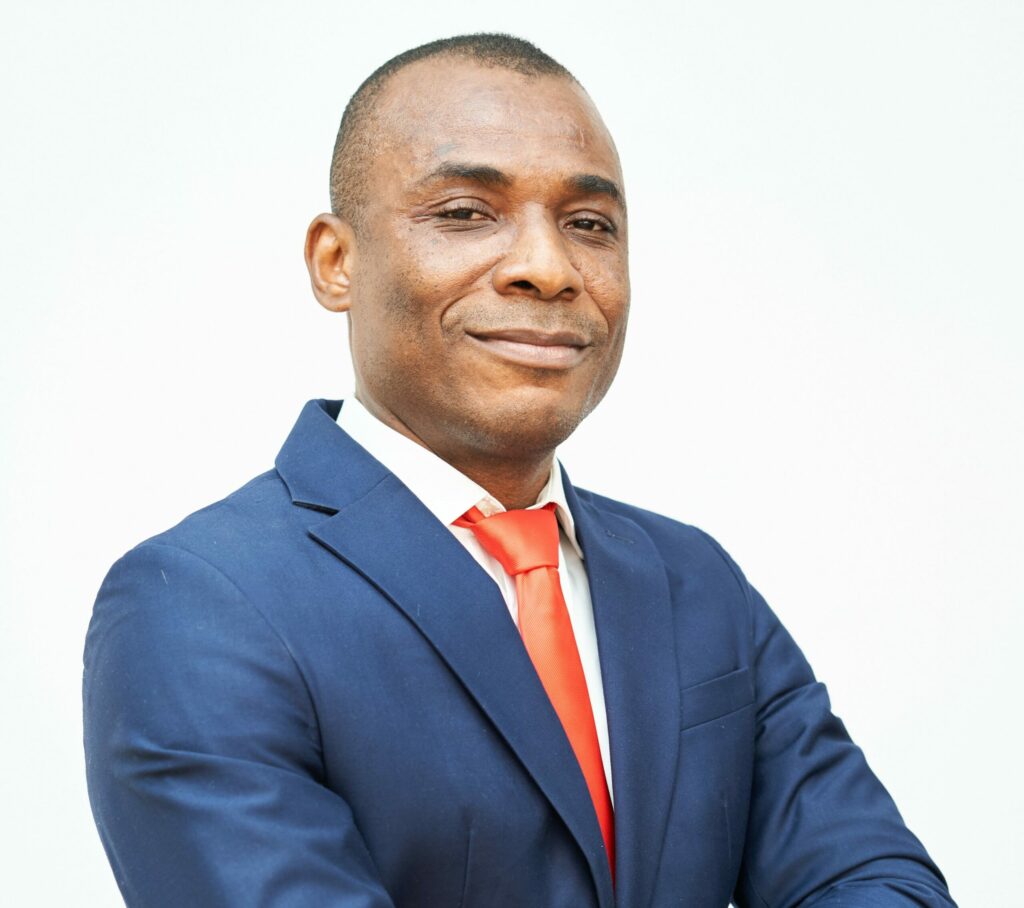
“We set out to make world-class financial services available to everyday consumers and businesses so that a student in Benin, a market trader in Kano or a salary earner in Lagos could all transact, save and grow their businesses with the same ease as someone in London.”
In the palm of one’s hands–that’s how easy accessing money should be. However, that is not always the case. It is also why, for this fintech, the mission was clear from the very beginning.
“Before we launched, if you knew the Nigerian terrain well, you’d understand that more than half of adults were unbanked, and cash dominated everyday commerce,” Chika Nwosu says.
He adds that even those with bank accounts, cards, or those transacting through banks still often preferred to use cash—largely because of service issues and high failure rates. At the time of PalmPay’s inception, for example, failure rates were as high as 20%. Sometimes, upon making a transfer, Nwosu says money would hang and if people needed to use POS systems, they would encounter one problem after another.
“When you went to the bank to resolve it, the experience was often frustrating. That was one of the major reasons we started,” he tells FORBES AFRICA.
“We set out to make world-class financial services available to everyday consumers and businesses so that a student in Benin, a market trader in Kano or a salary earner in Lagos could all transact, save and grow their businesses with the same ease as someone in London.”
PalmPay focuses on three areas: distribution, network reliability, and affordability; this is to ensure that they enable cost-effective and wide-reaching distribution by reaching underserved populations. Nwosu says this was developed via their smartphone-based banking app and built on a nationwide network of over a million mobile money agents and merchants.
“We operate in all 774 local government areas in Nigeria. We’ve made it a priority to reach even the most rural areas. When it comes to reliability, we have a transaction success rate of over 99.9% on the platform,” he says.
“And, in terms of affordability, we offer free transfers. Many banks charge around 53 naira ($0.03) or even up to 100 naira ($0.06) as a surcharge—but with us, it’s completely free.”
For PalmPay, their philosophy is a simple one: tackle financial inclusion. “We are doing in Nigeria to ensure that we provide the best financial services to our users.”
Ayotunde Alabi
CEO, Luno Nigeria
Founded: 2013

“Crypto is futuristic, and so is AI. Bringing both together means more efficient, more responsive finance.”
Ayotunde Alabi stands tall and regal in the studio in Ikoyi, looking less like a tech executive and more like a Baale (Yoruba chief) at a coronation. The CEO of Luno Nigeria is vibing to Burna Boy’s latest album, titled, No Sign of Weakness, as it plays through the studio speakers.
As one of the tracks fades, Alabi turns to the sound tech and says with a grin, “Run that one back”. Ever the music head, he knows all the artists featured in the playlist by name. He exudes calm, and is grounded and optimistic.
“There’s still so much opportunity here,” Alabi says. “This country is teeming with young people hungry for solutions; hungry to build. And that’s why fintech will continue to rise… not just fintech—agriculture, healthtech–it’s all open.”
Luno Nigeria, led by Alabi since 2024, became the first digital assets platform to establish local operations in the country, positioning itself, in 2017, as a bridge between the West African nation and the global crypto marketplace.
It’s a key player in Africa’s growing digital asset landscape, and is known for collaborating with fintech startups and banks to build infrastructure and ease transactions.
“We are more than just an exchange,” Alabi says. “We are a financial ecosystem.”
Luno allows users to buy and sell crypto assets. But its true innovation, Alabi explains, lies in its off-ramp capabilities—partnerships with fintechs that enable deposits, withdrawals, and seamless user experiences, even in a complex regulatory terrain.
This, he believes, is where the advantage kicks in.
“Nigerians are entrepreneurial by nature. When given the tools, they innovate. And that’s why we’re also bringing in tools like AI,” he says.
“We use it internally already. Our first-level customer interactions are handled by AI models trained, specifically, on the Nigerian market.”
At Luno, artificial intelligence is more than a buzzword; it’s foundational. The company has adopted AI tools to improve customer support and user experience. More recently, it began listing AI-related tokens like Bittensor (TAO), anticipating the convergence between blockchain technology and machine learning.
“AI will change everything—from how people trade to how they manage risk,” Alabi says. “Crypto is futuristic, and so is AI. Bringing both together means more efficient, more responsive finance.”
He also welcomes the growing involvement of regulators. With Nigeria’s new Investment and Securities Act (ISA) of 2024, the Securities and Exchange Commission is rolling out a tighter framework for crypto operators. Some startups have balked; Luno has leaned in.
“We see regulation not as a threat but a structure. It builds trust,” he says. “We’ve been engaging with the SEC. We want to help shape the landscape, not just comply with it.”
Luno’s strategy is simple: Be proactive, stay transparent, and build products that meet both customer needs and government expectations.
Somto Ifezue
CEO and Co-Founder, PiggyVest
Founded: 2016

“You can’t help someone financially if you don’t understand them. Data is the foundation of every decision we make.”
At the photoshoot for this feature, Somto Ifezue, the Co-Founder and CEO of PiggyVest, steps forward in a sharp crimson-like suit, a bold departure from his usual black uniform. His signature dreadlocks sway slightly as he speaks with the crew and his counterparts–enthusiastic and invested.
“When we started in 2016, we were probably the first consumer fintech company in this part of Africa,” he says. “We realized early that people weren’t saving and needed to address that.”
PiggyVest’s story of origin is now a well-worn narrative in West Africa’s fintech community. What began as a simple savings and investment automation tool has since grown into a platform serving over five million users.
At a time when trust in traditional financial institutions was at a low, PiggyVest introduced a new kind of discipline, appealing especially to young, mobile-first users who had never owned a fixed deposit account.
“The big problem was exclusion,” Ifezue says. “Without savings, you can’t access credit. You can’t plan. We wanted to fix that first.”
And they did—by designing a product as easy to use as Instagram, powered by behavioral prompts and strict withdrawal penalties. Suddenly, saving became easy and cool.
But now, in this ninth year of operations, PiggyVest is evolving again. The next frontier, Ifezue explains, is embedding finance into the everyday rhythms of African life—not just for the digitally-savvy, but for a wider demographic.
“We now have parents saving with us, and they’ve asked: ‘can we do this for our kids too’?” he says. “So, we’re launching PiggyVest Kids. Another one we’re piloting is called Salary Manager—it helps salaried workers budget in real time, taking their whole financial ecosystem into account.”
His voice becomes more animated when he speaks about what the team is doing with artificial intelligence.
“We already know what you’re saving for—school, rent, a business, so, we built an AI layer that analyzes all that data and then connects it with your bank accounts. From that, we can tell you how much to save daily, weekly, and monthly.”
It’s part of a broader shift from offering basic savings tools to becoming what Ifezue calls “a financial operating system”—a kind of intelligent planner that doesn’t just store your money, but helps you understand it.
PiggyVest has also begun laying the groundwork for cross-border expansion, testing how different African markets interact with financial products.
“Some places still rely on SMS,” he notes. “Some are app-first. It’s all about understanding how people use money in their context. We’re moving slow, but intentionally.”
Even with the optimism in tech, Ifezue still sees data—not code—as the company’s most valuable asset.
“You can’t help someone financially if you don’t understand them,” he says. “Data is the foundation of every decision we make.”
Tosin Eniolorunda
Founder and Group CEO, Moniepoint
Founded: 2015

“The future of fintech will be defined by how well we can use AI to turn raw data into real insight…”
The Competition Authority of Kenya (CAK) recently approved Moniepoint’s (formerly TeamApt) proposal to acquire 78% in the country’s Sumac Microfinance Bank. The move, along with its recent expansion of digital banking tools and remittance services for the African diaspora, helped push the Nigerian fintech past the $1 billion valuation mark, making it the country’s latest unicorn.
But for CEO, Tosin Eniolorunda, the milestone is merely a checkpoint.
“At the heart of the financial inclusion conversation is accessibility,” he tells FORBES AFRICA.
“We aim to provide financial products and services that meet the young people where they are. Clearly because we are speaking to a mobile-first generation, we’ll increasingly continue to deliver value in a manner that is seamless, secure and prioritizes great user experience.”
Moniepoint, founded in 2015, began by solving a deeply local problem: the lack of access to reliable financial services for Nigeria’s vast informal sector. In crowded markets and at roadside stalls, where cash is king and formal banking seems out of reach, Moniepoint deployed point-of-sale terminals and, later, mobile apps to bring merchants into the formal economy—one transaction at a time.
Today, it serves 10 million businesses and individuals, processing $17 billion monthly. But its vision has outgrown its origin story.
“We see that a lot of the challenges, which Moniepoint continues to solve for in Nigeria–financial exclusion, fragmented payment systems, and informal sector inefficiencies–are prevalent across other emerging markets,” Eniolorunda says.
“We want to build a financial ecosystem online and offline that helps Africa’s youth achieve their goals, dreams and aspirations as individuals, small businesses and entrepreneurs.”
It’s a message that resonates on a continent where financial exclusion remains stubbornly high and where more than 400 million of over 1.5 billion people remain unbanked, according to AfricaNenda Foundation–a pre-project planning and support provider for inclusive payments.
With the launch of MonieWorld, a digital platform for Africans in the diaspora, Moniepoint is betting big on cross-border connection. The platform allows users to remit money, access foreign exchange, and manage banking needs from wherever they are—bridging continents and communities with just a few clicks.
“Our expansion is never random; it’s deliberate and phased,” Eniolorunda explains. “We’re building an all-in-one financial platform that delivers payments, banking, credit, and business tools, especially for communities that have long been underserved.”
That seamlessness, he insists, must be underpinned by technology that understands both the nuance and urgency of local realities. In that regard, AI plays a starring role.
“The real potential of AI lies in its ability to make sense of massive amounts of unstructured data, like customer feedback and transaction patterns,” Eniolorunda says.
“We’re using it to solve real problems like automated credit underwriting, making it easier and faster for small businesses to access the capital they need.”
He envisions an even more intelligent future, stating: “Credit products tailored to a farmer in Kano might look very different from those designed for a merchant in Nairobi, and AI makes that possible.”
“The future of fintech will be defined by how well we can use AI to turn raw data into real insight, and deliver tools that help every individual and business not just access financial services, but thrive because of them.”
Adewole Adedeji
Co-Founder and Executive Director, Starks Associates
Founded: 2022

“There’s no one-size-fits-all here. You need to understand every country—from exchange regulations to cultural nuances—and build something that respects that.”
Dressed in a sharp black suit, Adewole Adedeji, Co-Founder and Executive Director of Starks Associates, is adept at multitasking. His day seems to be a mix of urgency and necessity, not unlike the market Starks operates in.
“In Africa, there’s over $2 billion trapped due to currency restrictions,” he explains between takes, eyes darting to his laptop. “Our job is to unlock it.”
Founded to power the financial rails behind Africa’s most challenging cross-border transactions, Starks Associates has become an invisible yet vital force in the region’s fintech ecosystem. Its specialty? Making payments seamless and compliant across over 15 African countries, with backend infrastructure built for speed, flexibility, and real-world nuance.
Starks began by supporting some of the continent’s best-known players, including Afreximbank’s Pan-African Payment and Settlement System (PAPSS). Today, it’s the silent backbone for sectors like aviation, telecoms, and FMCG companies grappling with moving money across a fragmented continent.
Adedeji draws on an analogy from the aviation sector. “You have airlines based in Africa like Kenya Airways or RwandAir, and then you have foreign ones like British Airways,” he explains.
“We already serve the African-based carriers—helping them extract funds from tough markets and convert them into usable currencies in countries like Kenya, Rwanda, and South Africa.”
But this is only one side of the coin. For the foreign airlines, Starks has built an alternative corridor.
“Instead of struggling to extract dollars from countries with tight capital controls, they can now use our pan-African infrastructure to convert and repatriate through Kenya or Nigeria, where new laws have improved FX access,” he says.
The impact of such interventions go far beyond corporate boardrooms.
Across Africa, small businesses routinely face delays—or dead ends—in moving capital. For trade-driven SMEs, the inability to secure credit or fund invoices creates a bottleneck that strangles growth before it begins.
Starks is attempting to solve that problem with a layered approach: embedded AI, real-time liquidity analysis, and an understanding of trade behavior beyond traditional data points.
“AI is a no-brainer for us,” Adedeji says. “We’re using it not for the buzz, but because we need it to score clients in countries where there’s no credit bureau, or where access to financial history is impossible.”
That means feeding non-traditional data—like payment patterns and trade history—into machine learning models that can assess risk and recommend funding decisions. The goal is to create a system where SMEs can receive financing using trade-backed instruments, like invoices or letters of credit, even without formal credit history.
It’s a distinctly African solution for a deeply African problem.
“There’s no one-size-fits-all here,” Adedeji says. “You need to understand every country—from exchange regulations to cultural nuances—and build something that respects that.”
On the multi-currency side, Starks is building its next phase: a platform where any African business open accounts across borders and settle payments within hours—ideally, within seconds.
“Right now, we’re settling trades in a few hours,” he says. “But we’re pushing for automation to make it feel instant–flash payments across Africa.”
At the photoshoot for FORBES AFRICA, Adedeji finishes the final frame, glances at his watch, then at the door. He barely waits for the camera to stop rolling before he dashes off for his next big meeting.
Ifelade Ayodele
Founder and CEO, Blaaiz
Founded: 2023

“From the very beginning, we adopted very sound corporate governance in our structure and how we scale.”
Ifelade Ayodele, the Founder and CEO of Blaaiz, moves with a calm that contrasts the energy at the photoshoot he is at for this magazine.
His voice, however—measured, firm, and deeply intentional—has been guiding Blaaiz through the noisy terrain of West Africa’s fintech landscape since its founding in 2023. The company has carved a reputation for methodical growth, hinting at a longer game.
“From the very beginning, we adopted very sound corporate governance in our structure and how we scale,” Ayodele says. “We’re one of the few fintechs in the region that has one of the Big Four auditing us. That’s deliberate. Transparency and accountability matter.”
Founded as a “dependable financial partner” for Africans at home and in the diaspora, Blaaiz started as a cross-border payments solution and has since grown into a multi-service platform—supporting trade, remittances, welfare transfers, and mobility financing.
“We want to be there for people wherever their next opportunity takes them,” Ayodele adds. “Whether you’re moving for work or sending money back home, we want to simplify that journey.”
Blaaiz’s ambitions are tightly intertwined with the continent’s demographic and economic future.
Emerging markets like Nigeria, Ayodele notes, are expected to drive a significant portion of global growth by 2035.
“By 2050, one out of every three people on Earth will be from an emerging market, especially Africa,” he says.
“With that growth comes the need for mobility, for trade, for cross-border solutions. We’re positioning ourselves to support those transitions.”
That positioning includes Blaaiz’s participation in PAPSS, an initiative of Afreximbank aimed at simplifying payments across the continent. It has also partnered with global multinationals to expand access and interoperability.
“These springboards help us stay ahead,” Ayodele says, “but they also allow us to build services that are fit for our ecosystem. They help us compete fairly, and more importantly, sustainably.”
The company is also embracing AI, with use cases focused on fraud detection, risk exposure, and customer interaction.
“We’re probably one of the most pro-AI companies in the space,” Ayodele says, humbly. “Our customer experience team uses AI to respond more quickly, and we use real-time data for rate setting and operational efficiency. But it’s not just about speed—it’s about being better.”
Blaaiz’s commitment to slow, deliberate innovation makes it something of an outlier in Nigeria’s fast-moving fintech ecosystem. In a sector known for unicorn valuations, aggressive funding rounds, and relentless scaling, Ayodele’s brand of leadership offers a different narrative—one that prioritizes structure over hype, and long-term stability over overnight success.
The company has expanded to serve markets beyond Nigeria—supporting money transfers across the United States, United Kingdom, Europe, Canada, Tanzania, Kenya, and Uganda—and is eyeing new corridors where remittances and trade services are underserved.
His words may not have boomed across the studio, but they echoed with clarity. In a region where volume often equals visibility, Blaaiz is betting on substance to make its mark. And if Ayodele’s vision holds, the future of West African fintech may just belong to those who speak softly—and build wisely.
Comments (0)
Sign in to join the conversation.
Related Stories

Equatorial Guinea: Charting A New Era Of Sustainable Prosperity
With a renewed focus on diversification and digitalization, Equatorial Guinea is leveraging its resources to create inclusive, long-term growth. “Agro-processing is a key priority, as our goal is to ultimately achieve national self-sufficiency and independence.” President Teodoro Obiang Nguema Mbasogo Equatorial Guinea is entering a new phase in its economic story–one defined by diversification, competitiveness, and connection. […]

Foundations Strengthening A National Future
Policy reforms, national capabilities, and coordinated institutions reinforce long-term growth across Equatorial Guinea. Q. How is your ministry advancing the national development agenda across key sectors such as agriculture, energy, and tourism, and what priorities guide your efforts to drive long-term economic growth and self-sufficiency? Hon. José Juan Ndong Tom Mekina, Minister of Agriculture, Livestock, Forestry, […]

Equatorial Guinea’s Energy Reset And The Revival Of Its Hydrocarbons Sector
As Equatorial Guinea reshapes its position in the regional energy market, GEPetrol is steering the shift to secure production, attract reliable partners, and align upstream growth with long-term economic goals. “Our strategic vision is to develop projects that are sustainable in the long term, and that also revive the economy.” Bienvenido Nguema Envo, General Manager of GEPetrol In 2024, […]
Recommended




The Daily Brief