

When The Desert Blooms: Hiking Africa’s Largest Canyon
A still morning on day four; the Namibia Fish River Canyon

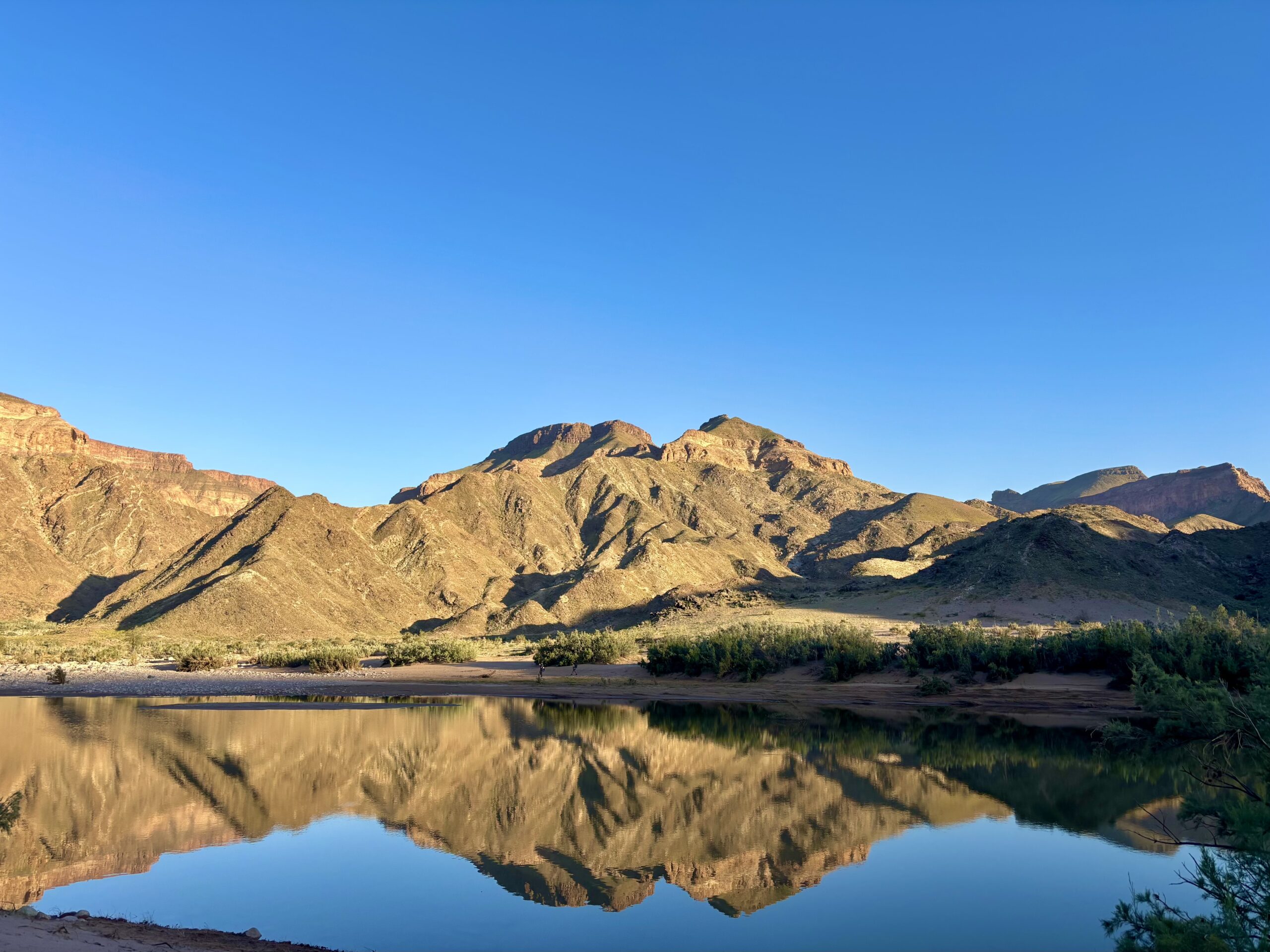
There’s a fine line between beauty and the extreme; in Namibia’s Fish River Canyon, you traverse through both. You could say that its spectacularity often came from its brutality.
Despite facing the almost standard 70-kilometer trail, typically done over five or six days, the usual tribulations differed this time. The mountains were in a heady state of bloom. After years of drought, widely considered to be one of Namibia’s worst in a hundred years, heavy rainfall in June had triggered the evacuation of 96 hikers via helicopter.
The canyon remained closed for nearly four weeks. Over a fortnight after reopening, a group of 11 of us descended into the canyon, nervous but excited. The experienced folk remembered it for being breathtaking but harsh, the obvious combination of water scarcity and high temperatures leaving little room for error.
But on this occasion, they left with memories of lushness and rapids—the antithesis of the desert terrain within which the canyon resides.
In the midst of celebrating our adventure, an equally-jubilant hiker relayed a conversation with someone days before–in the midst of their 20th Fish River expedition–that they had never seen flora in the canyon like we did now.
Having traversed through the lime-yellow wildflower fields they spoke of, a unique, gentle hue amplified by its purple, pink, and white compatriots, and then dramatized by the backdrop of rolling red mountains sporting intense stripes of various greens, it was a notion hard to argue against.
Such a kaleidoscope of color presented itself on several occasions, as though one kept stumbling upon overground reefs.
However, before reaching any of these luminous settings, a grueling first day to the riverbed awaited. It was tough for two reasons: your backpack is at its heaviest, and the first few hours follow a steep, rocky path. Full concentration is necessary to avoid tumbling to the bottom.
Once adjacent to the river, the first swim feels almost spiritual. Your periphery is now bordered by ancient cliffs nurturing the water below; they become companions leading us to our finish line– numbers 12 and 13 of the group.
Ahead of us lie jagged rock passes, panoramic mountain bends, river crossings, exposed flats, and sand—lots of sand. Meanwhile, random droppings of baboons and other predators, possibly leopard, hyena, or caracal, are a reminder that we are not alone. Snakes, such as the Cape Cobra and Puff Adder, alongside zebra and wild horses, complement the surrounding menagerie of untamed animals.
Birds chirp and flicker along the way, the calling of fish eagles and owls an almost every day and night occurrence. Life is thriving beneath the earth’s surface, a breath of fresh air following years of a ruthless reality.
You can’t tame the wild, but it can tame you. When the only way is downriver, you move to its rhythm, sometimes at snail’s pace, traversing towering sharp rocks, before being led to an open pathway minutes later, while river crossings, often done jumping rock-to-rock as we try to counteract the balance of our 20-something kilogram backpacks, demand patience and foresight.
Unique features amplify the walk’s spontaneity, from boiling Sulphur springs to the iconic Four Finger Rock and Three Sisters formation. The man-made landmarks in between provide further thrills, but, like describing the latest movie to someone waiting to watch it, some details are best kept secret.
Sometimes the magic of a place comes from unraveling the unknown.
Sleeping under the stars, it’s hard not to entertain Fish River mythology. Once a popular hunting ground for the indigenous Nama people, local folklore disputes that the winding canyon was formed by water erosion, believing its geology was modified by a giant serpent, known as Koutein Kooru.
The tale goes that the giant serpent once devoured Nama livestock until hunters worked together, using fire and hunting dogs, to kill it, its thrashing death throes carving the elaborate winding loops we see today.
Rare landscapes can be hard to put into words, especially when it morphs into a new personality at every bend. Some sections are arid, others an oasis, but seldom, if any, do they follow in uniform, each corner like changing chapters in a book.
Gusts of wind, kicking up sandstorms, and chilly nightfall temperatures struggled to dampen spirits. Perhaps it was Mother Nature being too exquisite to care about its challenges, or maybe it’s the perseverance that wild adventures can self-instill, whereby hurdles are expected and, in some ways, make the journey sweeter.
The memories become the glue that bonds the group, a shared adventure experienced at a miraculous moment in time.
It’s hard not to feel small under the soaring canyon, but the sensory overdrive is huge. Humbled by nature, no walk in the canyon is ever the same as it continuously evolves under the ever-shifting climate the world can’t seem to contain.
Comments (0)
Sign in to join the conversation.
Related Stories

Equatorial Guinea: Charting A New Era Of Sustainable Prosperity
With a renewed focus on diversification and digitalization, Equatorial Guinea is leveraging its resources to create inclusive, long-term growth. “Agro-processing is a key priority, as our goal is to ultimately achieve national self-sufficiency and independence.” President Teodoro Obiang Nguema Mbasogo Equatorial Guinea is entering a new phase in its economic story–one defined by diversification, competitiveness, and connection. […]

Foundations Strengthening A National Future
Policy reforms, national capabilities, and coordinated institutions reinforce long-term growth across Equatorial Guinea. Q. How is your ministry advancing the national development agenda across key sectors such as agriculture, energy, and tourism, and what priorities guide your efforts to drive long-term economic growth and self-sufficiency? Hon. José Juan Ndong Tom Mekina, Minister of Agriculture, Livestock, Forestry, […]

Equatorial Guinea’s Energy Reset And The Revival Of Its Hydrocarbons Sector
As Equatorial Guinea reshapes its position in the regional energy market, GEPetrol is steering the shift to secure production, attract reliable partners, and align upstream growth with long-term economic goals. “Our strategic vision is to develop projects that are sustainable in the long term, and that also revive the economy.” Bienvenido Nguema Envo, General Manager of GEPetrol In 2024, […]
Recommended




The Daily Brief