

EnterpriseNGR Report Highlights Financial Services’ Growing Role in Nigeria’s Economy
EnterpriseNGR’s State of Enterprise Report 2026 examines banking, insurance, capital markets, pensions and fintech, highlighting the sector’s contribution to investment, enterprise and economic resilience.

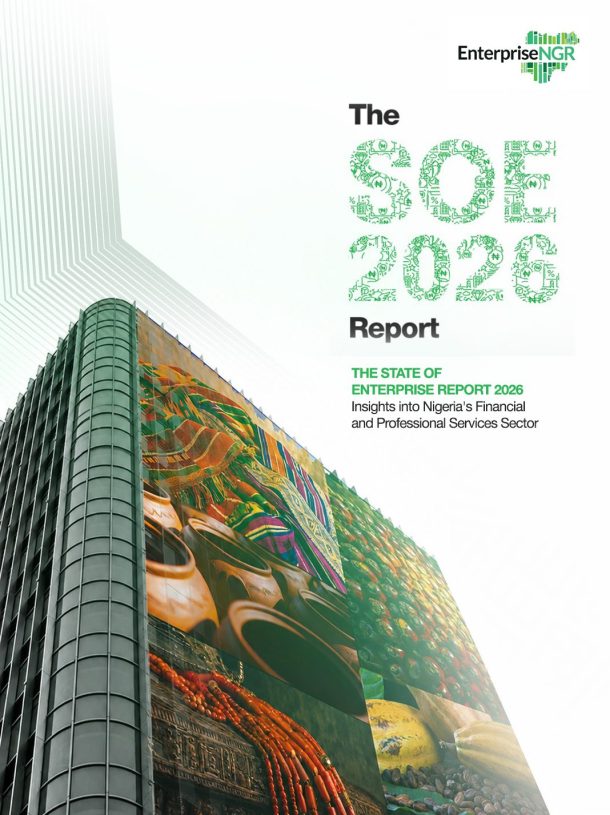
Nigeria’s financial and professional services sector is playing an increasingly important role in capital mobilisation, enterprise development and economic activity, according to EnterpriseNGR’s State of Enterprise Report 2026.
The report examines banking, insurance, capital markets, asset management, pensions, non-interest finance, fintech, professional services and sustainable finance. Its findings point to the sector’s importance in supporting businesses and investment through a period shaped by inflationary pressure, tight monetary conditions, exchange-rate adjustments and structural reforms.
Among the headline figures reported from the study, deposit money banks’ total assets rose to ₦180.37 trillion, equivalent to 41.8 per cent of nominal gross domestic product. Financial and insurance activities contributed ₦1.50 trillion, or 30 per cent, of company income tax collections, alongside ₦421 billion in value-added tax.
The report also records strong activity in capital markets. The Nigerian Exchange All-Share Index rose by 51.19 per cent in 2025, while market capitalisation increased by 58.3 per cent to ₦99.38 trillion and reached ₦129.21 trillion by the first quarter of 2026. Insurance gross premiums written increased by 47.3 per cent to ₦2.30 trillion, while pension assets grew to ₦27.45 trillion.
EnterpriseNGR says the sector’s contribution extends beyond financial institutions themselves. Banking, payments, insurance and capital markets provide channels through which businesses raise funds, manage risk, receive payments and plan investment. The report argues that stronger institutions and deeper financial intermediation can help support wider economic activity.
It also identifies persistent gaps, including limited financial inclusion, low insurance penetration, shallow capital-market liquidity, gaps in informal-sector pension coverage, data limitations and skills needs. These challenges indicate that headline growth must be matched by broader access and stronger institutional capacity.
The report was unveiled in Lagos on 2 July 2026 at an EnterpriseNGR Members’ Night. The organisation described it as an evidence-based resource intended to help business leaders, investors and policymakers make better-informed decisions.
The findings underline the growing weight of financial and professional services in Nigeria’s economy, while highlighting the work still required to translate sector expansion into wider opportunity for businesses and households.
Sources: EnterpriseNGR, State of Enterprise Report 2026; BusinessDay, “EnterpriseNGR report spotlights Nigeria’s financial, professional services sector as engine of growth,” 7 July 2026; Vanguard, “EnterpriseNGR report identifies financial services as key driver of Nigeria’s economic growth,” July 2026.
The Daily Brief
Get the daily FORBES.NG briefing.
Comments (0)
Sign in to join the conversation.
Related Stories

South Africa Investment Conference Spotlights Capital for Growth and Jobs
The 2026 South Africa Investment Conference brings attention to efforts to mobilise investment for infrastructure, industry and job creation in the region’s largest economy.

Why Africa Is Drawing Attention as Investors Assess the Continent’s Growth Potential
At the Milken Institute Global Conference 2026, speakers examine Africa’s investment potential and the policy, infrastructure and capital requirements for sustainable growth.

African Investment Outlook Focuses on Capital, Infrastructure and Regional Growth
Bloomberg Live’s Financing Africa’s Next Chapter discussion examines the capital, policy and infrastructure priorities shaping investment and business growth across the continent.
More from FORBES.NG
South Africa Investment Conference Spotlights Capital for Growth and Jobs
The 2026 South Africa Investment Conference brings attention to efforts to mobilise investment for infrastructure, industry and job creation in the region’s largest economy.
Why Africa Is Drawing Attention as Investors Assess the Continent’s Growth Potential
At the Milken Institute Global Conference 2026, speakers examine Africa’s investment potential and the policy, infrastructure and capital requirements for sustainable growth.
African Investment Outlook Focuses on Capital, Infrastructure and Regional Growth
Bloomberg Live’s Financing Africa’s Next Chapter discussion examines the capital, policy and infrastructure priorities shaping investment and business growth across the continent.
Recommended



The Daily Brief