

The South African Milliner Reclaiming Head Space, One Hat At A Time
Crystal Birch has spent over a decade building one of South Africa’s last hat factories from a nearly century-old Cape Town building–while remaining, by industry convention, largely behind the scenes. She is now returning to the art she fell in love with as a child, with the Brim Institute, her new non-profit betting that preservation–not …

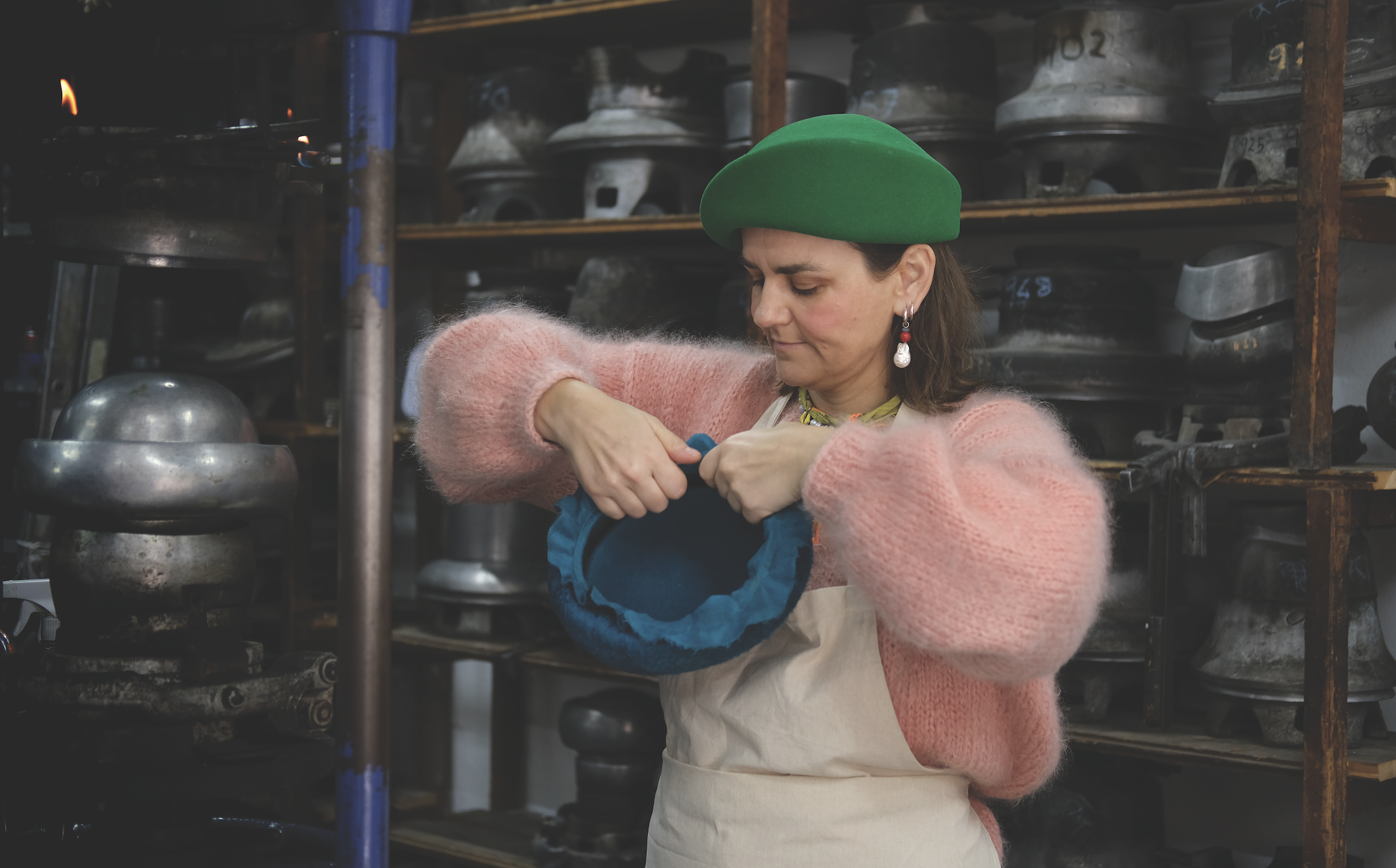
Crystal Birch has spent over a decade building one of South Africa’s last hat factories from a nearly century-old Cape Town building–while remaining, by industry convention, largely behind the scenes. She is now returning to the art she fell in love with as a child, with the Brim Institute, her new non-profit betting that preservation–not production–is the future of her craft.
The Crystal Birch brand and Hat Factory operates out of a small, unassuming warehouse in Gardens, Cape Town. Three blockers, the specialized machinery used to shape hats, line the back wall, while the front of the studio is adorned with every kind of hat imaginable. Birch herself is a walking advertisement for her work, an eclectic mix of local design and thrifted clothes, topped off with one of her own creations.
Despite this slick style, Birch comes from rural roots. She spent her childhood on a farm and airfield in Limpopo, one of South Africa’s provinces, with parents who softened high-stress careers with creativity. “My mother was in finance but very creative with interiors and gardening, and my dad was a pilot and qualified lawyer,” she says. Her grandmothers, she believes, shaped her most: one was a master quilter and the other a renowned watercolorist.
“It was the ultimate 1990s childhood,” Birch reflects. “Small towns breed a lot of imagination. The smaller the town, the bigger the imagination.”
Unsurprisingly, she went on to study fashion, and it was at a seminar tied to SA Fashion Week that she first heard the now-late Albertus Swanepoel, the South African-born milliner, speak. This was the moment she realized hats could be a career and his advice stuck with her: “If you want to become a specialist, decide early in your career so you can refine your craft.” Around the same time, still a student, she discovered Parisian Milliners, the Cape Town factory founded in 1936, that would eventually become her own. After an internship in Los Angeles convinced her a conventional design career wasn’t for her, she found her way into styling instead, first at Cape Town’s Madame Zingara, then during a move to London, which began a 13-year career.
In 2010, she moved back to South Africa, while still in the throes of styling all over the world. Her industry’s unforgiving pace, coupled with her desire to slow things down for the arrival of her daughter, eventually led her to Parisian Milliners and Harry Faktor. Having first met him when she was studying, she moved into the factory years later, making hats on weekends while styling during the week. Eventually clients started booking her simply to make hats. “For a year, I worked there for Harry for free because I just styled and merged the two as I was trying to wean myself off of the film industry,” Birch says, adding that she turned a by-appointment showroom serving mostly choir hats into a public storefront with exhibitions and a younger clientele.
Then came 2020. The factory stayed open through the Covid-19 lockdown by supplying mourning wear, classified as essential, alongside a pivot into masks and visors, doing well as funerals remained one of the few gatherings still permitted. Then, on October 1 that year, she bought the business outright.
Tough times and legal hurdles followed, when her team shrank from 38 to 12, with constant turnover. Design, sales, marketing, and product development for her own label and several private clients all sit with Birch. She hasn’t designed a new collection in over two years. Yet, after another brutal festive season, she admits she collapsed under burnout and it reframed what winning meant. “I do not think success is growing,” she says. “I think success is peace. A regulated nervous system and free time.” She has since hired her first accountant, handed off social media, and is planning her first unreachable holiday in a decade.
Burnout also sharpened a long-standing frustration: milliners don’t get nearly enough recognition. She counts 11 runway shows in one season featuring her hats without a single mention of who made them, contrasting it with London’s convention of naming the specialist. “The reason we are the forgotten accessory is because designers conveniently forget to mention us,” she says. “You are erasing us by not mentioning us.” Going forward, uncredited work is off the table, alongside a broader frustration at the lack of institutional support for the craft in South Africa.
Her answer, however, isn’t a bigger factory; it’s a smaller one, plus the Brim Institute, aimed at preserving millinery as a craft rather than scaling it as a business. It grew out of South Africa’s Social Impact Arts Prize that she won, along with a two-month residency in the Karoo town of Graaff-Reinet, where she taught local teenagers while running her factory remotely.
“Millinery, literally, means the art of hat-making,” she says. “I want the institute to be a laboratory.” Her long-term goal is to inspire young people to explore the art of hat-making as a career.
What has emerged from the Crystal Birch who dedicated decades of her life to her work isn’t a founder chasing scale, it’s someone trying to return to the instinct that had her wearing a hat in the bath as a child. “One hat goes through 12 sets of hands and we’ve been making hats the same way they’ve been made for 400 years,” she says. “I want to get back to the art, back to the design, back to the conceptual, back to the playing–the Brim Institute has given me the ultimate playground to do that, so I’m not just ‘the hat lady’ anymore.”
The Daily Brief
Get the daily FORBES.NG briefing.
Comments (0)
Sign in to join the conversation.
Related Stories

South African Entrepreneur On The Biggest Impact Of The Smallest Ingredient In Your Meal
In South Africa’s Northern Cape province, two-and-a-half hours north of Upington, where the Kalahari Desert stretches towards the Namibian border, lies a salt pan–a flat, dry lakebed that turns white with crystals in the summer heat. Beneath it sits a 55 million ton underground aquifer, and the salt drawn from it now sells in more …

Pitch To Pinot: The Rugby Player Building A Wine Brand In South Africa
A crippling back injury at the age of 31 left professional rugby player Burton Francis at a crossroads, but sent him chasing his second passion, winemaking, and he was in the best possible place to pursue his new dream. Francis grew up in Paarl in South Africa’s Western Cape province, so was used to grapevines …

Wavers News: Building a Global Digital Media Platform Through News and Information
Operating under Wavers Multimedia, Wavers News covers Nigerian and international news across business, politics, education, technology, entertainment, sports and other areas of public interest.
More from FORBES.NG

Jensen Huang Gains $33 Billion As Nvidia Stock Soars
Topline Jensen Huang gained $33 billion on Monday after he was reinstated as Nvidia CEO, pushing him up five spots in Forbes’ billionaire rankings to 13th richest person in the world, after the chipmaker’s stock recovered from its slump after he stepped down over an alleged Chinese spy scandal. This story was first published on …

‘Grand Theft Auto VI’ Passes $1.8 Billion In Revenue On Release Day—Eclipses ‘The Odyssey’s Box Office Total
Topline The highly anticipated “Grand Theft Auto VI” has already generated $1.84 billion in revenue as of release day, according to estimates by market research firm Sensor Tower, edging out the total worldwide box office gross of summer phenomenon “The Odyssey.” This story was first published by Forbes.com Key Facts “Grand Theft Auto VI” has …
Recommended

The Daily Brief